 1
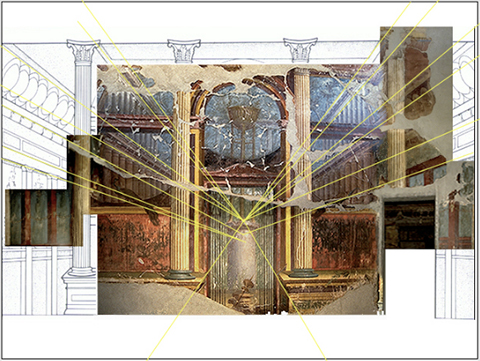
1Perspective used to link theatre sets and wall-paintings
One of the structural features that all of the wall-paintings have in common is a sophisticated use of linear and atmospheric perspective. Whilst it may not conform to the geometric and mathematical laws postulated in the Renaissance it nevertheless displays an exceptional understanding of the psychology of visual perception (fig.1).
Ancient theatre historians attribute the early evolution of perspective techniques to stage scenery, citing as proof ancient texts such as the one in which Vitruvius states that Agatharcus was the first painter to create the illusion of depth in scenery painting (Vitr.7.0.11). Phyllis W. Lehmann and Stella G. Miller, on the other hand, convincingly point out that perspective found in Macedonian tombs, such as The Tomb of Lyson and Kallikles at Lefkadia, may have acted as a precursors for perspective in Second Style wall-painting (fig.2). For more on this topic see Approaching the Wall-Paintings.
1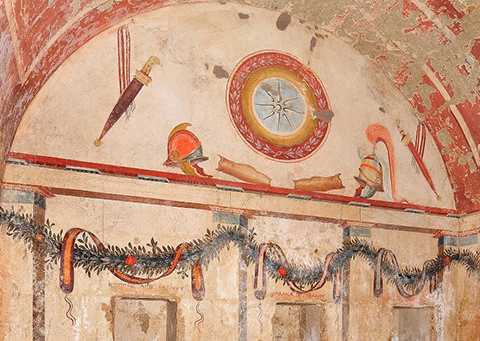 2>
2>


|