11

Picasso and de Chirico
Anxiety caused by loss relating to filial relations, self-image and sexual potency, are all mainstream psycho-physical preoccupations. What was not so mainstream was the extent to which these anxieties consciously and unconsciously sublimated in the work of Picasso and de Chirico. Clearly, for both artists, life and art was symbiotic. Picasso openly acknowledged this fact by meticulous dating every thing he produced, thus leaving a visual autobiography for others to decipher. The extent to which Picasso and De Chirico engaged in deep self-analysis in order to generate their work is highly doubtful. In fact they may well have consciously avoided the temptation to intellectually reflect on their oeuvre, preferring instead to cherish the muse that instinctively and emotionally propelled their work. And, perhaps even more significantly, strive to see the world through the eyes of a child. They undoubtedly preferred poetic insight to intellectual dissection and their oeuvre reveals that they were uniquely capable of making poetic observations concerning their personal pathography and their differing preoccupations with mortality.
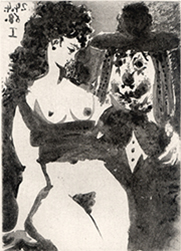
Picasso, for the majority of his creative life engaged in an Oedipal relationship with the matriarchal presence, which allowed him to symbolically re-enter the womb in a vain attempt to achieve virtual immortality. Finally, even the great pretender had to acknowledge the truth and confront his fear of impotence and death. As the artist’s virility wained in his later years, Picasso the artist became Picasso the voyeur. No longer able to fully engage with his subject, he transforms the ageing bull/Minotaur into an ageing clown or monkey, a voyeur in his own creation. He invites our empathy, if not sympathy, whilst at the same time reclaiming his narcissistic loss by means of his still virile creative potency as an artist (Fig.1&2).
De Chirico took another path to the same goal, preferring instead to pass through his paternal false-door (antiquity and ancestry) and the key that he used to open his door was provided by the lost art of metaphysical-perspective (Fig.3-4).
 1
1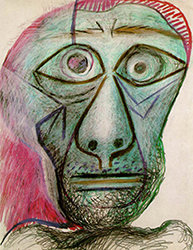 2
2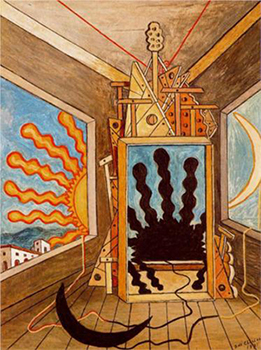 4
4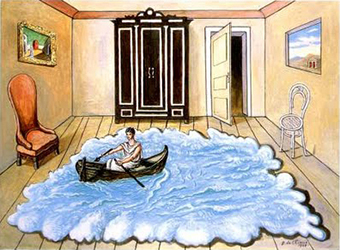 3
31. Pablo Picasso Old Clown with a charming woman 1968-71
2. Pablo Picasso Self-portrait 1972
3. Giorgio de Chirico Ulysses Returns 1968
4. Giorgio de Chirico Metaphysical Interior 1971
11
