French flag

In "Limits Not Frontiers of Surrealism", André Breton the most influential of the Surrealist writers claimed that in 1914 the “...intervention of Picasso and Chirico in the domain of painting,” caused “….visual forms of representation” to dramatically change.* The history of twentieth century painting went on to confirm Breton's early diagnosis.

Pablo Picasso fondly referred to Giorgio De Chirico as the painter of railway stations. De Chirico, in an equally brief but admiring comment, described Picasso as a painter of bullfights and big women. Their seemingly casual summaries transpired to be more astute than either may have realised. By juxtaposing modernity with machismo and fecundity they exposed the gender differences that underpin their work.

The following text expands on the inherent gender differences in their work and concludes that they were shaped by patriarchal and matriarchal loss during adolescence, …one driven by the paternal family line, the other by the maternal, one seeking after the metaphysical and the Apollonian, the other after the physical and the Dionysian.

* Breton 1937: Eng., trans.1971, in Surrealism, edited by Herbert Read p.102.
1
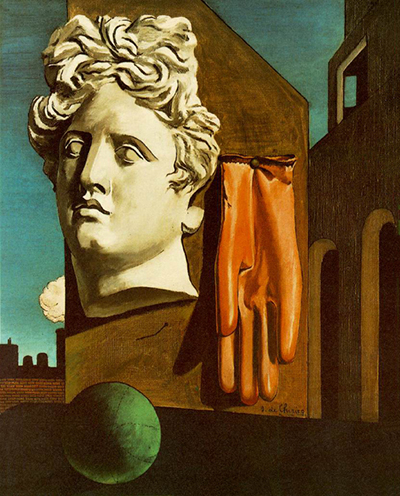
Somg of love 2014 1

1.Giorgio de Chirico The Song of Love 1914

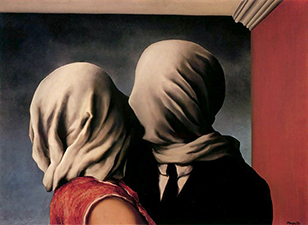
2.René Magritte The Lovers 1928


Railway Stations and Minotaurs: gender in the paintings of Giorgio de Chirico and Pablo Picasso
Trauma resulting from parental loss, both actual and metaphorical, is one of the most disturbing experiences that the psyche confronts, especially so in the susceptible mind of an adolescent. Much has already been written on this theme in relation to the pathological development of artists such as: Leonardo de Vinci (Sigmund Freud 1919); Michelangelo Buonarroti (Robert Liebert 1983); and René Magritte (Martha Wolfenstein 1974). But, somewhat surprisingly, Giorgio de Chirico and Pablo Picasso’s have largely escaped the clinical gaze of both psychoanalysts and psychologists, which is a surprising oversight given Magritte’s declaration that on seeing De Chirico’s The Song of Love (1914) he broke down and cried because for the first time he realised that painting was capable of profound forms of poetic expression (Fig.1). To which I would add ‘powerful forms of sublimation’. * Whilst not wishing to denigrate Magritte or Wolfenstein (a child psychologist), I would point out that the pathographic link between Magritte’s painting The Lovers (1928) and the trauma caused by his mother’s suicide is illustrative in its poetic exegesis (Fig.2). The cathartic reunion expressed by the “lovers” passionate kiss clearly sublimates the trauma that the adolescent Magritte experienced when recovering his mother’s lifeless body from the river in which she was found floating, her head covered by her white nightdress. No such obvious correlation exists between parental loss and adolescent trauma in the the work of de Chirico or Picasso. To reveal that we must dig deep beneath the complexities that shaped their work.

Since I am not a psychologist or psychoanalyst I will limit the extent to which this essay strays into their territory and only use the clinical term sublimation when referring to cultural practices that cathartically alleviate collective or personal trauma — catharsis [heal] and trauma [wound] from the Greek. From a collective perspective creative sublimation in the visual arts ranges from depictions of pre-historic fecund goddesses to post-pagan crucifixions; to the origins of tragic drama in Greek Dionysian rituals to the pursuit of the sublime in idealised landscape painting — and so much more.
Bibliography
Updated : 08-01-2026
Magritte The Lovers 1928 2