 1>
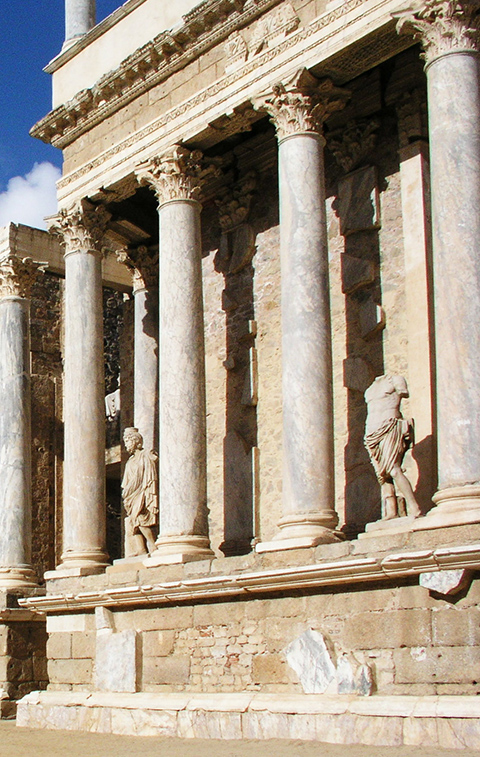
1>By the latter part of the twentieth century, however, Ingrid Rowland and Thomas Howe's 1999 'new' English translation of De Architectura confidently removed all ambiguity, stating that in large rooms ".... they painted 'stage sets' in the tragic, comic, or satyric style,..." (Rowland & Howe 1999 : 91). One suspects that their confidence was bolstered by two factors. One undoubtedly relates to the numerous twentieth-century writers who claimed that scaenarum in 5.6.9 and scaenarum frontes in 7.5.2 were both references to stage scenery. The other concerns a more pervasive form of linguistic coding. During the twentieth-century scaenae frons, a variant form of scaenarum frontes increasingly came to signify the colonnaded facade at the back of the typical Roman theatre (fig1). It is now the commonly accepted term despite the fact that no Latin writer, including Vitruvius, used this phrase as a name for the colonnaded stage facade. His use of the phrase was purely locational. Why should this be significant and in what way could it have impacted on subsequent translations of De Architectura?
Scaenae Frons
In the corpus of ancient Latin literature scaenae frons appears only once and that is in De Architectura. In 5.6.1 it is used to describe the position of the 'front of the scaena (stage)', "Ex his trigonis cuius latus fuerit proximum scaenae, ea regione, qua raecidit curvaturam circinationis, ibi finiatur scaenae frons, ...". "Of these triangles, the side of that which is nearest the scene (proximum scaenae), will determine the face thereof in that part where it cuts the circumference of the circle." (Gwilt); and "Of these triangles, the side of that which is nearest the scene (proximum scaenae),, let the front of the scaena be determined by the line where that side cuts off a segment of the circle..." (Morgan). It also appears in reverse form in Book 5.7.1 " Et ab ea regione ad extremam circinationem curvaturae parallelos linea designatur, in qua constituitur frons scaenae, ..." "Parallel to this line and tangent to the outer circumference of the segment, a line is drawn which fixes the front of the “scaena”,..." (Gwilt); and "On the same side, parallel to this a line is drawn to touch the outside of the circle, and on this the front of the scenery (frons scaenae), is marked out." (Morgan).
1>


© CC BY-SA 3.0, https://commons.wikimedia.org/w/index.php?curid=313044
|