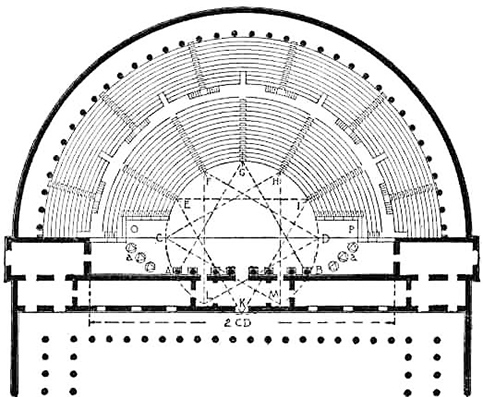
From the Latin passages and Gwilt and Morgan's translations we can determine that both scaenae frons and frons scaenae were both used to denote the location of the back of the stage, i.e 'front of the scaena' or 'nearest the scene'. In other words, in the context of De Architectura, scaenae frons and frons scaenae are both positioning phrases and not names for the colonnaded facade now commonly called scaenae frons. Their function is purely locational, similar to proximum scaenae (nearest the scene), in the same passage. Despite its original locational function scaenae frons found its way into the 1999 English translation of 5.7.1: " Of these triangles, take the one whose sides will be closest to the performing platform. There, in that area that cuts the curve of the circle, layout the scaenae frons, and draw a parallel line from the place through the centre of the circle,..." (Rowland & Howe 1999 : 69)
There are several other texts we can refer to in order to reinforce the point that neither Vitruvius nor any other ancient Latin writer used the term scaenae frons or scaenarum frontes to name the facade at the back of the theatre. The clearest example appears in Book 7.5.5 in which Vitruvius used scaenam, episcaenium and scaenae to describe the ornate architectural edifice that Apaturius of Alabanda designed for the back of the small theatre stage at Tralles:
"...etenim etiam Trallibus cum Apaturius Alabandeus eleganti manu finxisset scaenam in minusculo theatro, quod ἐκκλησιαστηριον apud eos vocitatur, in eaque fecisset columnas signa Centauros sustinentes epistylia, tholorum rotunda tecta, fastigiorum prominentes versuras, coronasque capitibus leonis ornatas quae omnino stillicidiorum e tectis habent rationem, praeterea supra eam nihilominus episcaenium, in quo tholi pronai semifastigia omnisque tecti varius picturis fuerat ornatus, itaque cum aspectus eius scaenae propter asperitatem eblandiretur omnium visus et iam id opus probare fuissent parati,..."
"For instance, at Tralles, Apaturius of Alabanda designed with skillful hand the scaena of the little theatre which is there called the ἑκκλησιαστἡριον representing columns in it and statues, Centaurs supporting the architraves, rotundas with round roofs on them, pediments with overhanging returns, and cornices ornamented with lions’ heads, which are meant for nothing but the rainwater from the roofs, —and then on top of it all he made an episcaenium in which were painted rotundas, porticoes, half-pediments, and all the different kinds of decoration employed in a roof. The effect of high relief in this scaena was very attractive to all who beheld it, and they were ready to give their approval to the work, when Licymnius the mathematician came forward and said that..." (Morgan). (ἑκκλησιαστἡριον: Ekklesiasterion or meeting place).



|