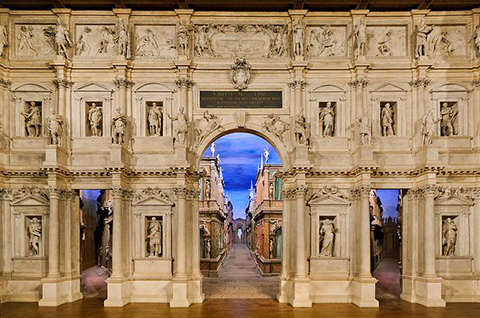
And yet Margarete Bieber wrote in her highly influential publication The History of the Greek and Roman Theatre,… “A scaenae frons painted by Apaturius of Alabanda for the ecclesiastrion at Tralles, …..is mentioned by Vitruvius (VII.5.5) (Bieber 1971 : 168). Bieber’s insertion of scaenae frons into Vitruvius's Apaturius text may well have influenced the later Rowland & Howe translation of the same passage, which states that….”Apaturius set his elegant hand to decorating the scaenae frons of the tiny theatre,…” and then substituted scaenae frons for both episcaenium and scaenae in the same passage (Rowland & Howe 1999 : 92). H.G Beyen illustrated Apaturius's design by means of a drawn reconstruction with the caption, "Die Scaena Frons des Apaturius". He reproduced Vitruvius's account of the design by taking visual elements from at least three different Pompeian wall-paintings.
One can make a similar point in connection with passages concerning the theatre and the colonnaded façade at the back of the stage, in Pliny the Elder’s Natural History (Naturalis Historia), written only a few decades after De Architectura. Several writers have made reference to Pliny's description of the extravagantly luxurious use of columns and statues in a 'scaenae frons' commissioned in 58 B.C. by M. Scauri (Pliny the Elder Naturalis Historia 36.114-15). However, when we examine Pliny's text we find that he, like Vitruvius, used the word scaenae and not scaenae frons to describe the colonnaded facade at the back of the stage. Why is this important? After all the history of naming is fraught with numerous examples of linguistic transference and slippage. In this context I believe it is important because the now ubiquitous use of scaenae frons has undoubtedly reshaped contemporary readings of the key passages in De Architectura that are used to link ancient stage scenery to domestic wall-painting. As a result it is not uncommon to find many architecturally orientated wall-paintings labelled as depictions of scaenae frons.
Subsequent to Vitruvius's use of the phrase scaenae frons to describe only the location of the stage, it did not appear in text form until the late nineteenth-century, when it re-appeared in the 1890 version of A Dictionary of Greek and Roman Antiquities under the subject heading 'Theatrum'. “The Roman type of theatre is simply the Greek type modified in certain particulars. The ground-plan is thus described by Vitruvius. In a circle, of the same diameter which the orchestra is to have, inscribe three equilateral triangles. Take one side of any triangle, and let this be the back wall of the stage, scaenae frons (A B)." (William Smith 1890 : 820).



|