
The re-appearance of the Latin words scaenae frons in the 1890 Smith dictionary, nearly two thousand years after its exclusive appearance in Vitruvius's De Architectura, may well have caused its subsequent association with the colonnaded facade at the back of the stage. However, in this context I don't think its re-appearance was intended to imply that Vitruvius used this phrase as a name for the back of the stage, or the front of the stage, depending on how you view this feature. I think it was inserted into the English text in order to clarify the translators reference to the ‘back wall of the stage’, which Vitruvius’s Latin text describes as the front of the stage (scaenae frons). Morgans’ later translation required no such clarification because his translation closely mirrored the Latin original. “Taking that one of these triangles whose side is nearest to the scaena, let the front of the scaena be determined by the line where that side cuts off a segment of the circle (A-B), and draw, through the centre, a parallel line (C-D) set off from that position, to separate the platform of the stage from the space of the orchestra”. Morgan’s translation even differentiates, as does Vitruvius’s, between the ‘scaena’, the colonnaded façade at the back of the stage, and the stage itself the ‘proscaenii pulpitum’. As does Gwilts earlier translation: “Of these triangles, the side of that which is nearest the scene will determine the face thereof in that part where it cuts the circumference of the circle. Then through the centre a line is drawn parallel to it, which will separate the pulpitum of the proscenium from the orchestra.” Although less clear than Morgans’ translation it nevertheless makes the same distinction between ‘pulpitum of the proscenium’ meaning the raised stage and the ‘face thereof’, meaning the façade in front of which the actors perform. The latter is referred to using the Italian word for stage scena, whereas Morgan used the Latin scaena.
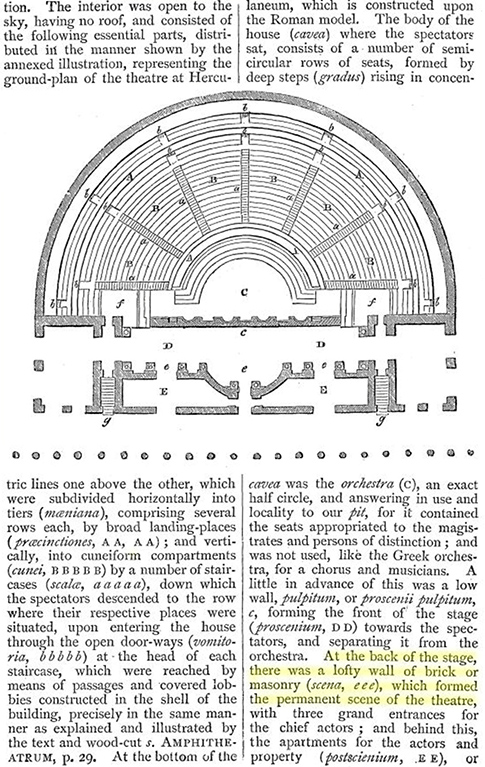
In common with all dictionaries prior to Smith’s 1890 publication, Anthony Rich's A Dictionary of Roman and Greek Antiquities clearly named the façade at the back of the stage as the ‘scena’..."At the back of the stage, there was a lofty wall of brick or masonry (scena, e e e ), which formed the permanent scene of the theatre, with three grand entrances for the chief actors ;..." (Rich 1874 : 655) (fig 1).
As early as 1867 Thomas H. Dyer's in Pompeii: Its History, Buildings, And Antiquities made an intelligent attempt to name the colonnaded facade at the back of the stage, "The ancient scene was not, like that of the modern stage, capable of being shifted. It consisted of a solid building (scena stabilis), representing the facade of a royal palace, and adorned with the richest architectural ornaments." (Dyer 1867 : 193). Dyer's late nineteenth century attempt to allocate a logical name to this permanent facade fell on deaf ears and approximately two decades later scaenae frons and not scena stabilis began to appear repeatedly in major academic publications that specifically focused on the history of the Greek and Roman theatre.


 1
1
|