 1
1Academic publications concerned with Roman art and architecture in general, such as August Mau's Geschichte Der Decorativen Wandmalerei In Pompeji (1882) and Pompeji in Leben und Kunst (1900), (Pompeii its Life and Art, 1901) contained no reference to scaenae frons. Mau was thoroughly conversant with Vitruvius’s De Architectura and often cited it to support his observations, but when discussing the theatre he used phrases such as “When plays were presented, the front of the palace at the back of the stage was concealed by painted scenery." ...and... "On such occasions we may suppose that the front of the palace at the rear of the stage served as a background without other decoration." (English translation: Pompeii 1901 : 147-148) In contrast, academic publications specifically concerned with Greek and Roman theatre, published at the same time, began to use the phrase scaenae frons to name the facade at the back of the stage.
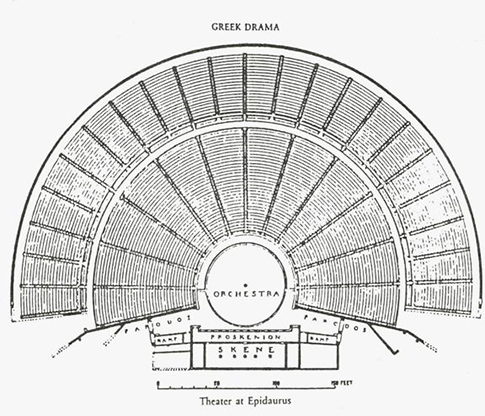
This trend may have begun with the 1896 publication of Das Griechische Theater by Wilhelm Dörpfeld and Emil Reisch, in which the words scaenae frons are initially introduced in parenthesis, similar to its first appearance some six years earlier in Smith's A Dictionary of Greek and Roman Antiquities. "Ganz entsprechend liegt auch im Dionysos-Theater nicht nur die vordere Wand der Skene, die «scaenae frons», sondern auch das zu ergänzende Proskenion in solcher Entfernung von dem Centrum des Orchestrakreises, dass der vorhandene Halbkreis bequem zu einem ganzen Kreise ergänzt werden kann." (Dörpfeld and Reisch 1896 : 55) "Accordingly, in the theatre of Dionysos, not only the front wall of the skene, the “scaenae frons”, but also the complementing proskenion, are both such a distance from the center of the orchestra circle, that the existing semicircle can easily be completed to a full circle".
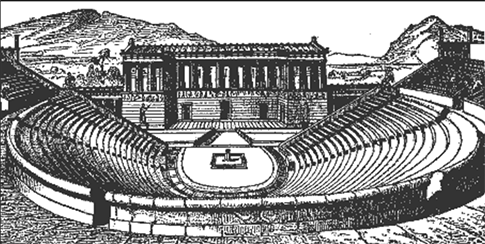
The appearance of saceane frons in the Dörpfeld and Reisch text is somewhat puzzling, because it is first used in connection with the Greek Theatre of Dionysos in Athens. Vitruvius, in contrast, only used it in a passage exclusively concerned with the Roman theatre (5.6.1). Dörpfeld and Reisch, subsequently used both scaenae frons and frons scaenae throughout the rest of their publication to name the colonnaded facade at the back of both the Greek and Roman theatre, even though there is no surviving material evidence for such a multi-tiered structure in Greek theatre. Their transitional use of scaenae frons from a once purely locational phrase to a name, significantly influenced later publications. What is even more surprising is that it occurred despite their own reservations concerning the use of this phrase. In "Die Namen der einzelnen Teile der Theater." (The names for the individual parts of the Theatre) on page 167 they wrote, "Endlich war auch der Name scaenae frons insofern nicht ganz genau, als die vor der Skene stehenden Säulen richtiger als Proskenion bezeichnet werden." “Finally, the name scaenae frons was not truly accurate, as the columns in front of the skene should more correctly be named the Proskenion.
1


 2
2
|