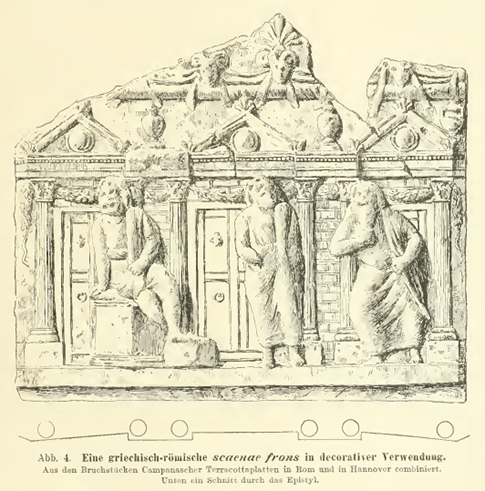
One can understand why the early theatre historians such as Dörpfeld and Reisch focused on the Latin conjunction of scaenae and frons. The Greek word προσκήνιο (proskenion) from which we get our word 'proscenium' is a conjunction of προ (in front or before) and σκηνή (tent), hence 'in front or before the tent'. The tent in this instance is the place in which the travelling actors prepared their costumes and the proskenion is thought to have been the 'painted scenery' cloth that was hung in front of the tent, which the actors performed in front of. When the Greek theatre evolved from a temporary to a permanent stone structure the proskenion evolved into a stone structure. As the Romans transformed this structure into an increasingly elaborate facade, with multiple tiers of columns, entrances, niches and sculptures, a new name was required to distinguish it from the Greek 'proskenion'. Proscaenium, the Latinised form, would have been a perfectly rational choice, but Dörpfeld and Reisch, possibly influenced by A Dictionary of Greek and Roman Antiquities and a desire to seek the academic underpinning of De Architectura, chose scaenae frons, even though as I have pointed out earlier Vitruvius did not use this phase as a name for this edifice.
The next significant academic publication to use the term scaenae frons was Otto Puchstein's Die Griechische Bühne: Eine Architektonische Untersuchung. It was published in 1901, just four years after Das Griechische Theater and unquestioningly adopts Dörpfeld and Reisch's use of the term scaenae frons, whilst at the same time criticising Dörpfeld's chapter "Das grieschische Theater Vitruvs" in Mittheilungen des Kaiserlich Deutschen Archäologischen Instituts Athenische Abtheilung (Band XXII 1897 : 439-462) for giving no example of a Greek "Proskenion" transforming into a scaenae frons,...."Aber was mir gegen Dörpfelds Ansicht schon allein zu genügen scheint, lässt sich kurz sagen. Er hat kein einziges Beispiel nachgewiesen, wo thatsächlich aus einem griechischen Proskenion eine römische scaenae frons geworden wäre (vergl. Athen. Mitth. XXII 1897, 458)."..."However, the only criticism of Dörpfeld's opinion can be briefly stated. He has shown no factual examples where a Greek proskenion is remodelled into a Roman scaenae frons (vergl. Athen. Mitth. XXII 1897, 458)". (Puchstein's 1901 : 25).
By 1906 the phrase scaenae frons was so commonly used that Gustave von Cube wrote his PhD thesis on its presence in Pompeian wall-painting, Aber die römische ‘Scena Frons' in den miscomprehended Wandmalerei 4. Steels. In terms of the naming of parts, the transition of scaenae frons from a locational group of words to an architectural name, is of little consequence except to those concerned with the history of ancient Graeco-Roman theatre and Romano-Campanian wall-painting. Many of the names we attribute to ancient artefacts are largely based on post-discovery conventions rather than factual evidence. If the only consequence of this particular transition had been to provide a name for the colonnaded facade at the back of the Roman theatre, then I would not be labouring its origin quite so emphatically. It has, however, transpired to be more than just a name because its modern meaning, as opposed to its original Vitruvian usage, helped to substantiate a perceived link between ancient stage scenery and ancient Romano-Campanian wall-painting.
Little, whose work featured in the early part of this chapter, made the same point very succinctly in his 1936 Scaenograhia essay when he claimed that "vista elements of the style", meaning the Second "Architectural" style are, "scenographic", meaning stage



|