 1
1Garden Sanctuaries – paradeisoi
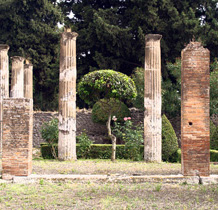
The internal axis and high walls that defined many Roman dwellings not only created internal security, but also an opportunity to create enclosed paradise-like gardens that added to the image of the house as sanctuary (fig.1). In his book on Apulian vase-painting, Smith points out that in order to create paradise you must first build a wall to contain it, ‘… my already frequent use of this half-Persian word (paradise) is now justified, for without a wall such as the door and the many windows of Italiote eschatology imply there can be no ‘paradise’.’(Smith 1972: 68) The origin of the word paradise literally means a walled space. The old English word paradise (heaven or heavenly) comes from the Church Latin word paradisus – where the righteous or blessed dead dwell), which in turn comes from the Greek paradeisos meaning garden or park. Going back even further, it is thought that the Greeks may have inherited the word from the ancient Persians, because of the similarity between the Avestan word pairidaeza, meaning an enclosed space (pairi – enclosing and daeza wall). Hence, for the Persians the walled garden signified an earthly manifestation of spiritual paradise, and this metaphor passed into pagan and then Christian after-life beliefs. The presence of water-shrines in many of the walled-gardens in Pompeii and Herculaneum suggests that the tutelary spirits and numina were also worshipped in this earthly version of paradise, in addition to other prominent places within the house (fig.2).
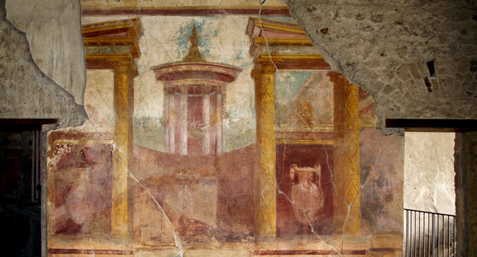
Wealthy families created seamless transitions between house and paradise garden in the form of peristyles (colonnaded walkways) and adjoining rooms that opened onto the garden by means of folding doors. Wall-paintings, such as those found in the oecus corinthius in the Casa del Labirinto, extended the paradeisos theme into virtual worlds inhabited by gods and ancestors (fig.3). The lateral walls both depicted tholos sanctuaries dedicated to Zeus and family ancestors and the wall opposite the garden was dedicated to Hekate (fig.4). A better preserved version of which exists in cubiculum M of the Villa Publius Fannius Synistor. In both versions Hekate is framed by a naiskos (shrine) located behind a gate leading to a walled sanctuary garden. The wall adjacent to the garden opened on to it by means of folding wooden doors, thus creating a physical merger between room and peristyle garden, similar to the transition between the room and the virtual sanctuaries depicted in the paintings. The oecus corinthius in the Casa del Labirinto was recently restored after a roof collapse damaged the paintings yet further, but in its prime it was a remarkable example of the physical and metaphorical interaction between the concept of the house as sanctuary and its enclosed paradise garden. The axonometric drawing of the oecus corinthius reproduced in Domus: Wall Painting in the Roman House (170), demonstrates the extremely high level of pictorial sophistication contained in this room, whilst also clearly showing that all three wall-paintings used the theme of the sanctuary-garden to further the theme of house as sanctuary.
Houses such as Casa del Bracciale d'Oro had Livia Drusilla's Villa at Prima Porta had entire rooms painted as if they were paradise gardens, in addition to the actual paradeisoi gardens, which they often bordered on to (fig.5).
1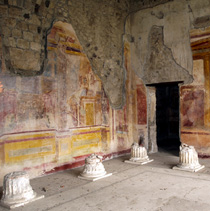 4>
4>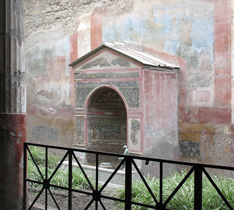 2>
2>


 3
3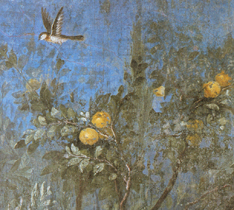 5>
5>
|