 1>
1>between church, state and the domestic environment in the Roman period. The primary one being that the boundaries between the religious and secular worlds were clearly demarcated and kept separate. However, as many writers have pointed out, there was no such clear-cut division in Italo-Roman society. Therefore the argument for two kinds of luxuria, one pertaining to religious institutions and the other to domestic environments, rapidly breaks down.
The interaction, and in some cases the inseparability, between religious and secular life is born out by the fact that the same people constituted the hierarchy that governed both domains. Priests, who were normally chosen from amongst the respected citizenry, orchestrated public religious expression and, quite often, they managed political and social affairs, and thus, both civic and religious control was invariably in the hands of the same people. The college of priests, as they were collectively called, performed all the necessary religious ceremonies, rituals and duties associated with civic life.
In the following passage Andreas Bendlin succinctly encapsulates a large body of opinion concerning the interaction between state and religion. “Indeed, the active, and sometimes aggressive, appropriation of religious rituals and ideas in the political arena proves that religion was an accepted part of the Republican elite’s mind set. Their behaviour attested to the societal centrality of religion in public life. Thus the link between magistracy and priesthood formed one crucial element in the self-development of the Roman elite. What has been called the ‘civic compromise’ (hence the reference in my chapter title) symbolises the elite’s perception of an inseparable connection between priestly and civic office, between religion in the city-state and political life, in short: between religion and the state”. (his parenthesis). Bendlin, in particular acknowledges Gordon 1990 as the source of his reference to ‘civic compromise’. (Bendlin, A. 2000:119)
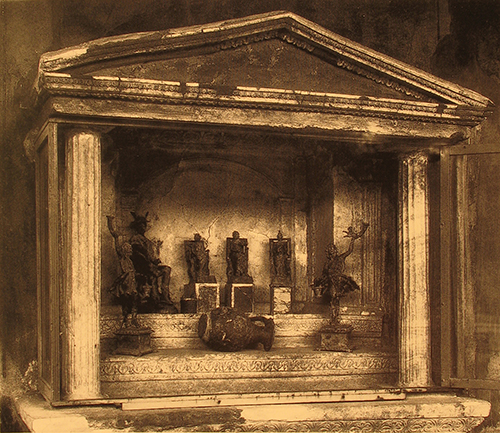
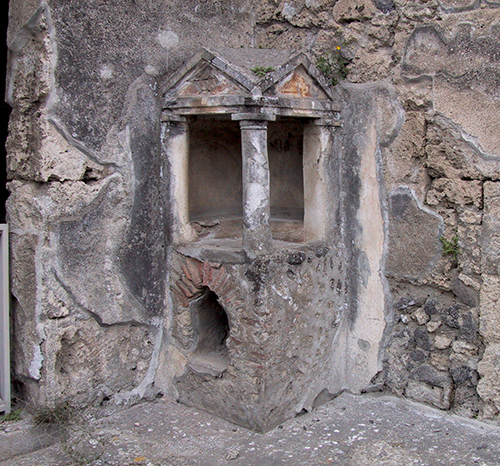
The blurring of secular and religious distinctions in governance was also echoed in the house. In addition to its domestic, social and business function it was also required to provide an environment for daily religious worship. This mostly entailed venerating and placating the household gods and other observances relating to family ancestors. The lararium, or family shrine, provided the focal point for the rituals associated with both of these practices and houses and villas often contained several lararia, serving different sections of the household. Their presence in cooking, sleeping and business areas suggests that no distinction was made between secular and religious spaces. Generally speaking, lararia varied between free-standing temple-like structures or temple facades incorporated into the fabric of the house in the form of painted niches or wall-paintings (fig.1&2). Business and religion were clearly not antipathetic because the main lararium was usually located in the atrium. One might conclude from this that its reassuring presence was conducive to the transaction of business because it emblematized respect for the gods and ancestors. In conjunction with other signifiers such as ancestral masks, it indicated to the visitor that the owner of this house was a pious person with a distinguished lineage. Not only did the elite and the business community have to have these traits, but they had to be seen to have them. This begs the question: if the wall-paintings were considered to be purely luxury items wouldn’t their ubiquitous presence run counter to the piety displayed by lararia?
1>


1 Lararium, Casa degli Amorini Dorati, Pompeii, the Capitoline Triad – Juno, Jupitor, Minerva, (the three seated figures on the right) are now in the Museo Archeologico Nazionale di Napoli
2
Lararium in the atrium of Casa di Obellio Firmo, Pompeii
 2
2
|