 1>
1>The merger of secular and religious worlds
The thesis that the Roman house was shaped by the pursuit of luxury is not only countered by the presence of lararia, but also the fact that the head of the family was analogous to a priest. It was his or her duty to orchestrate religious observance within the house, largely focused around lararia. Cato the Elder’s account of a nobleman dismissed from priestly office because he did not perform his religious duties at home exemplifies the importance attached to these rituals. (Bendlin 2000:126) Given the merger of secular and religious worlds within the Roman house, perhaps we need to reconsider the definition of luxury as ostentatious display, in favour of ‘luxuria’ as a coded form of visual expression that supported this merger.
By definition luxury and wealth are synonymous, but what did being wealthy in Pompeii actually entail? In the Republican period wealth and responsibility went hand in hand. If you had money then you were expected to spend it in ways that benefited the community. One very visible way of doing this was through the enhancement of the civic environment, either in terms of infrastructure or public monuments. This might entail upgrading a public building, such as, the modernising of Pompeii’s theatre, or the building of a new and lavish public bath. In some cases seemingly generous acts were linked to personal interests. For example, the bequest made by the six year old N. Popidius Celsinus towards the reconstruction of the Temple of Isis after the AD62 earthquake, has prompted several writers to conclude that the bequest was in fact made by his father, who was not freeborn and therefore unable to hold public office. His son, on the other hand, was freeborn and thus eligible for election to the ruling council at some future date, hence the bequest was made in his name and not his fathers. (Ward-Perkins and Claridge 1977:40). Public benefaction meant that you stood a significantly higher chance of being elected to the ordo decurionum, the cities powerful ruling council. Therefore, the possession of wealth was a complex mix of public duty and private indulgence. (For more on this theme see Pompeii AD79, 1977:38)
The very first painting that one encounters on entering the Casa dei Vettii demonstrates the very pragmatic relationship between wealth creation and luxury that seems to have existed in the Roman psyche. It features the image of Priapus complete with an enormous erection.
Luxury and iconology
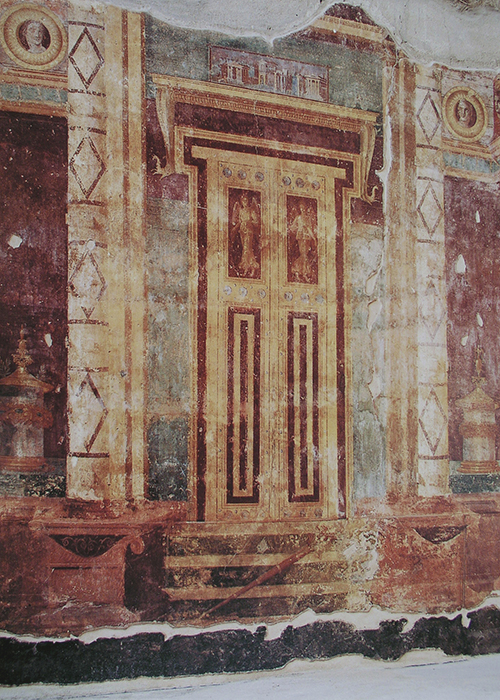
If, as many have suggested, the wall-paintings were used to display wealth and status, then the themes depicted in the paintings seem at odds with this intention. It would, for example, have been quite simple to replicate palace facades and palatial interiors in order to make the obvious visual connection between palace and house. And yet, the visual evidence overwhelming focuses upon religious and mythological subjects, such as the depiction of gods, sanctuaries, shrines, paradise gardens and sacro-idyllic landscapes; all of which appear to be themes that are conceptually at odds with the mindless pursuit of luxury and ostentatious display. For example, none of the elaborate architectural facades associated with either the Second, Third or Fourth Style replicate palaces. The Second Style is overwhelmingly concerned with the depiction of sanctuaries or temenos gardens, whilst the latter styles are characterised by paintings of shrines, sanctuaries and mythic encounters (fig.1).
1>


1 Villa di Poppea, Oplontis, detail showing one of four ivory and tortoiseshell doors located on opposing walls in the atrium. The vignette above this door depicts a street of tombs, thus indicating that this is not a depiction of a palace door but a door leading to Elysium.
|