 1
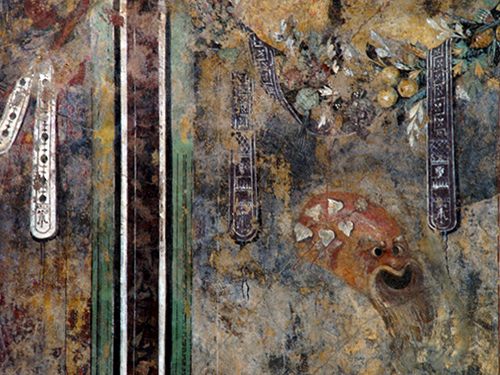
1Some argue that the many examples of architectural trompe l’oeil is evidence that the owners tried to create the illusion of palatial grandiosity by using wall-painting to expand the dimensions of their rooms. Once again the material evidence runs counter to this theory. Some of the most complex trompe l’oeil paintings, such as those found in the Villa di Poppea and the Casa del Labirinto, are already in very large rooms. Therefore, a further allusion to palatial space was hardly necessary. Some properties, such as the Casa del Fauno in Pompeii are often cited as being more palatial in scale than many Hellenistic places. Georgia Clarke, in her book Roman House – Renaissance Palace: Inventing Antiquity in Fifteenth-Century Italy, provides several revealing insights into the way in which fifteenth-century Italia may have skewered our understanding of the ancient Italo-Roman house. In this period Italy’s established families and its emerging nouveau riche both sought to acquire status through impressive houses that echoed Rome’s glorious past. The ‘old families’ associated themselves with antiquity in order to emphasise their genealogical status, whilst the newly rich attempted to use property to legitimise their wealth, which was largely acquired through banking, an activity that was generally thought to be un-Christian in the period that Clark is concerned with. The actual remains of ancient Roman houses were not sufficiently impressive enough to provide the kind of building models that would satisfy their quest for status and recognition and therefore ancient texts and the infinitely more impressive remains of public buildings such as triumphal arches, basilicas and temples provided the source material for reinventing the ancient Roman House (Clarke 2003: 127). In so doing modern perceptions of ancient Roman Houses became contaminated by later palatial reinventions. Unlike fifteenth-century Italy the properties in Pompeii and Herculaneum, regardless of size, were built using rubble in-filled volcanic lava walls and cement. Since the lava was pitted due to the gases trapped at the moment of solidification, the wall surfaces were upgraded by means of plaster and paint. The paint was initially used to mimic more expensive surfaces such as marble and arguably this could be described as luxury on the cheap. However, even at this stage auspicious commemorative objects were also depicted as if hanging on the marble wall (fig.1). The presence of these talismanic motifs suggests that the illusion of magnificence was in itself not enough. Even when more elaborate architectural depictions gave the impression that properties were built with expensive materials, the iconography, as detailed above, pointed the viewer in even more sanguine directions. The iconography in these paintings gave those that lived amongst them, the opportunity to visit worlds that the mere depiction of architecture for its own sake could never achieve. This suggests that the raison d’être for the paintings was more than simply the display of status and wealth.
If the owners considered the wall-paintings to be luxury items acting as prestige signifiers, then accessible viewing within the house would have been a key consideration. The material evidence from both Pompeii and Herculaneum suggests the opposite. Many of the public areas, such as the atrium, were not ostentatious and few would have been invited beyond this space. Many were decorated using the non-figurative First Style. Those invited deeper into the house would probably have been family members, close friends or special guests and
1


1 First-style wall-painting depicting a mask and hanging garlands of fruit (Cornucopia) draped with ceremonial betrothal ribbons, Palermo Archaeological Museum, Sicily
|