 1
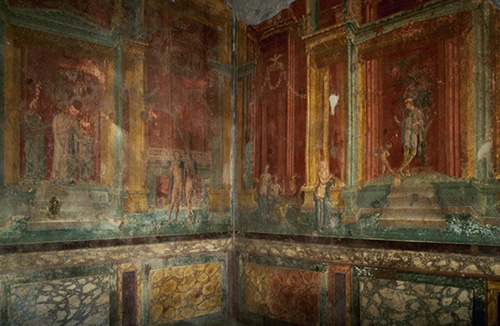
1therefore probably already accustomed to seeing wall-paintings, both inside and outside the house or villa. Living in Pompeii was, after all, like living in an enormous picture book, and the presence of wall-painting was a ubiquitous feature. Dunbabin’s review of Wallace-Hadrill’s Houses and Society in Pompeii and Herculaneum, 1994, critiques his use of the word ‘luxury’ in the chapter on ‘Luxury and Status’ and suggests that it is a ‘misleading’ term. She supports this view by quoting his observation that by the time of the Fourth Style, ‘….wall decoration was no longer the preserve of the elite….’, and therefore could not be considered a luxury item. (Dunbabin, K. M. D. 1995. “Houses and Households in Pompeii”. JRA V.8: 387-390:389) Therefore, it can be argued that the value and the significance attributed to wall-painting was determined by its content rather than its value as a status symbol, and content was the primary factor that determined its location. In both Pompeii and Herculaneum wealth and its relationship to house size did not lead to segregation. Small and large houses existed adjacent to each other and in some cases small houses contained wall-paintings that were of equal aesthetic value. Some small houses, such as the Casa di Cerialis Pinarius, contained paintings that were equal, if not superior, to those found in substantially larger premises (fig.1).
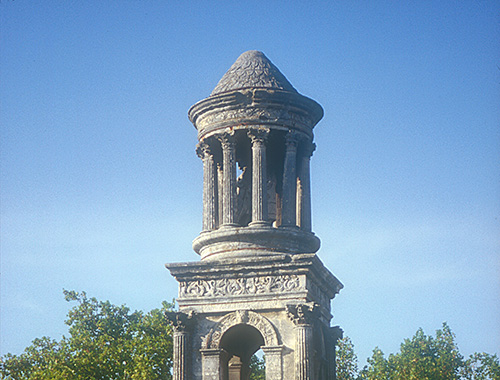
Since the Satyricon unwittingly played such a large part in constructing the view that domestically located wall-paintings contributed to the Italo-Roman hedonistic lifestyle, it might be fitting to conclude with two passages from it that counter that view. One states that ‘gold’ eclipsed wall-painting as the only true indicator of beauty and the other proposes that one should be equally concerned with the ‘house’ one will spend eternity in (fig.2).
“Do not hesitate, therefore, at expressing your surprise at the deterioration of painting, since, by all the gods and men alike, a lump of gold is held to be more beautiful than anything ever created by those crazy little Greek fellows, Apelles and Phydias!"
(Satyricon Chapter 88 final sentence)
“I want fruit trees of every kind planted around my ashes; and plenty of vines, too, for it's all wrong for a man to deck out his house when he's alive, and then have no pains taken with the one he must stay in for a longer time, and that's the reason I particularly desire that this notice be added:
--THIS MONUMENT DOES NOT--
--DESCEND TO AN HEIR -- ”
(Satyricon Chapter 71)
Both quotes taken from Project Gutenburg web edition
http://archive.org/details/thesatyriconcomp05225gut
1


1. Casa di Cerialis Pinarius, Pompeii
2. The Mausoleum of the Julii, 40 BC., situated near the ancient Roman site of Glanum (27BC-260AD), near Saint-Rémy-de-Provence, France
|