Case Study: Pompeii – Public and Private Life
A leading exponent of the thesis that Roman wall-painting is symptomatic of hedonistic desire is Paul Zanker. The following case study examines the way in which he uses it to underpin many of the views expressed in his publication Pompeii – Public and Private Life. Rather than test the patience of readers with a page-by-page analysis key themes are selected in order to summarise and examine the book’s underlying thesis. With all due respect to the author and in acknowledgement of possible errors associated with its translations from German to English, I must first point out that this case study is based on the 2000 English edition, first published in 1998 by Harvard University Press. The English translation was based on the 1995 German edition of Pompeji: Stadtbild und Wohngeschmack, which in turn was derived from three essays written between 1979 and 1993.
Wall-painting, in particular, provides much of the circumstantial evidence used to underpin the author’s thesis that Pompeian society aspired to surround itself with luxury items more usually associated with aristocratic life styles. The thesis is initially articulated in relation to the ‘old’ established families and their dwellings, but the full implications of it are more specifically outlined in the chapter on the ‘domestic arts’. This section attempts to demonstrate how the Pompeian ‘middle-class’ nouveau riche, in particular, succumbed to the temptations of Hellenistic hedonism. We are reminded, on numerous occasions that this exercise was doomed to failure, because they lacked both the education and the substantial wealth required to achieve it. The inevitable result being that they produced cheap imitations that only succeeded in impressing their equally culturally illiterate neighbours. We are lead to believe that the strategy that the upwardly mobile used to achieve their goal was to turn their homes into ‘imitations’ of royal or aristocratic dwellings, largely achieved by employing the mimetic skills associated with painting. Therefore, the interpretation of the wall-paintings within a domestic environment is crucial to the validity of this thesis.
The initial part of the book proposes a new way of studying the public and private life of the Pompeian’s, which it is claimed will lead us to an enriched understanding of their ‘tastes’. The methodology for achieving this is predicated upon an analysis of different types of urban and domestic environments and associated décor, in addition to material extracted from ancient literary sources. After applying this methodology in general historical terms the book then focuses entirely upon the ‘domestic arts’. By referring to it as ‘domestic art’, rather than art in a domestic environment, the author creates a sub category of art, that is no longer defined by the conceptual frameworks normally associated with art. Reframing the paintings in this way leaves them vulnerable to purely sociological interpretations, which is precisely the author’s intention, since they are used to determine not only the property owner’s aesthetic taste, but also their moral and ethical values.
Taste
Throughout the book, and particularly in the chapter on ‘domestic art’, problematical concepts such as ‘taste’ and ‘décor’, are used to legitimise the use of visual art as an index for determining social and cultural values.



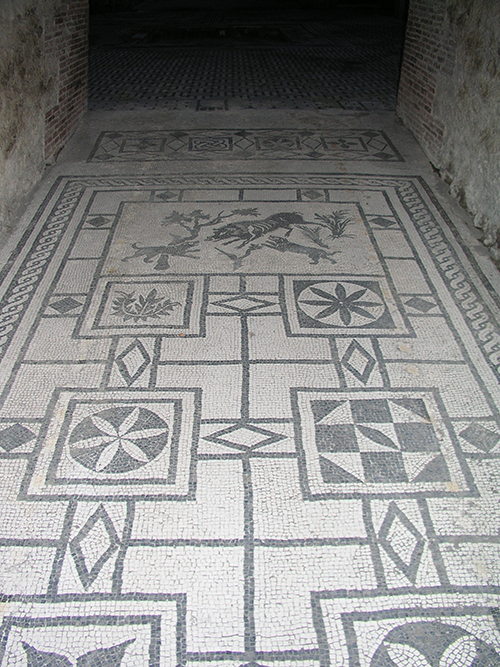
Floor moasic in the fauces (entrance) to Casa del Cinghiale, Pompeii.
This house acquired its name as a result of the mosaic vignette depicting two dogs hunting a wild boar (Cinghiale). The wild boar was concidered to be the harbinger of death and apotropaic or protective images such as this one, either in the form of mosaics or wall-paintings were often located in entrances in order to protect the house and household from evil.
|