 1
1At no point is the reader made aware of the problems inherent in this methodology. Historical research is fraught with methodological problems and those raised by Pompeii’s unique history can be particularly difficult to resolve. As Wallace-Hadrill pointed out, even seemingly straightforward questions such as what was the population of Pompeii at the time of the eruption, turn out to be highly contentious because of the number of variables involved. (Wallace-Hadrill 1994:91-103) Defining ‘taste’ presents an even greater set of difficulties and these grow exponentially as artefacts, individuals and societies recede historically. Historical distance further complicates the polysemic nature of images and their simultaneous capacity to function as signs, symbols, indices and even symptoms. Extrapolating an individuals taste from a given object requires the reversal of a very complicated semantic process involving so many variables as to make it almost impossible, except on a superficial level. For example, if two people possess similar artefacts, does that mean that they have similar tastes? Does an African mask hanging in a tribal village carry the same meaning as one hanging in a western apartment? Do their owners have similar tastes? One suspects not, since objects alone cannot determine taste and the context in which an object exists is clearly an important part of its potential as a signifier.
In Pompeii the cultural divide in terms of ownership was not as extreme as the example of the African mask, but according to the case study publication there also existed an external ‘aspirational model’ in the form of the palatial Hellenistic villa, to which the nouveau riche supposedly aspired (pp.16, 35, 136-14, et al). The latter is consistently used as a datum for measuring Pompeian taste in general. By substituting the ‘palatial villa’ for the ‘palace’ as a symbol of unattainable luxury, the object of desire seem less removed and therefore the coveting of it less absurd. At the same time the image of the ‘palace’ stands behind the villa as a kind of subliminal referent. Unlike the example of the mask, which is intended to illustrate the symbiotic relationship between object and context, the books ‘aspirational other’ acts as an object of nouveau riche desire and condemnation.
Palatial Villa to Hellenistic Palace
The author’s strategy throughout is to diminish Pompeian art and architecture by constantly referring to it as ‘imitation’. The ‘original’, the palatial Hellenistic villa never actually appears, except obliquely, in order to cast a disparaging shadow over the quality of Pompeian art, with the intention of exposing the ‘inferior taste’ of those who commissioned the wall-paintings. Designating something as an imitation or copy is a much-used strategy for discrediting artefacts. Unfortunately, it has very little meaning beyond modernist ways of thinking, since imitative processes such as copies, and copies of copies, was the historical norm with little or no pejorative connotations. The supposed ‘object’ of the Pompeian homeowner’s ‘desire’ - Hellenistic art, ‘imitated’ a myriad of other foreign sources. This is never alluded to because to do so would undermine the purity of the ‘original’, thus making the Pompeian ‘imitations’ less problematical. Quite the reverse in fact, because the ‘substantive other’ becomes more substantive as the book progresses and palatial villas give way to objects of desire in the form of Royal Palaces owned by Hellenistic monarchs (pp.35 & 136-143).
1


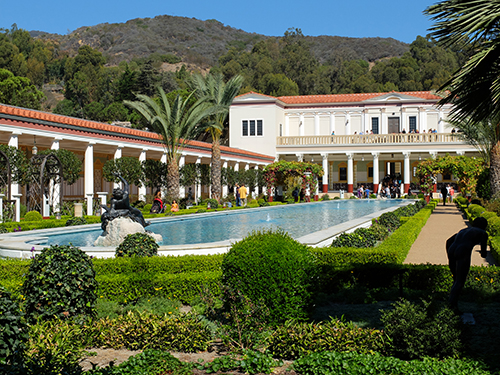
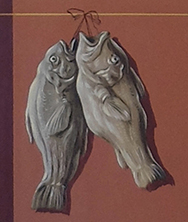
1 Since there is no existing unattainable 'other' that exemplifies the Hellenistic Palace so often referred to in Pompeii - public and private life, 2000, I am therefore, with more than a touch of irony, substituting the above photograph of the John Paul Getty Villa at Malibu, California. Zanker's criticism of ancient Roman wall-painting, in certain houses in Pompeii, as a type of 'Disneyfication' (p.156) or a ‘grotesque potpourri’ (p.189), is far more relevant to the paintings in this reconstructed villa based on the Villa of the Papyri, Herculaneum. They completely lack the sophisticated 'impressionistic' gestalt qualities that are very evedent in ancient wall-painting, excellent examples of which are found in the Getty Museum, which forms part of the Villa complex.
2 Modern wall-painting depicting fish (detail), J Paul Getty Villa, Malibu
3 Detail of an ancient wall-painting depicting ex-voto fish (expanded view >)
 2
2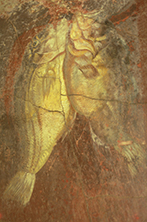 3
3
|