 1
1This creates an absurd gulf between the original and the ‘middle-class’ imitation, which leaves the occupants of the houses open to accusations of avarice. Once this has been established via the presence of imitative processes, the ‘imitations’ in the form of architecture, wall-painting and mosaic, are then considered to be symptomatic of the desire to obtain luxury. The mere presence of art becomes an index for luxury, regardless of its iconography. The fact that most of it is concerned with religious, metaphysical and paradisiacal worlds, and not the portrayal of Hellenistic palaces, is excluded from the book’s thesis, since it primarily rests upon art being both a symptom and a cure for the desire for luxury.
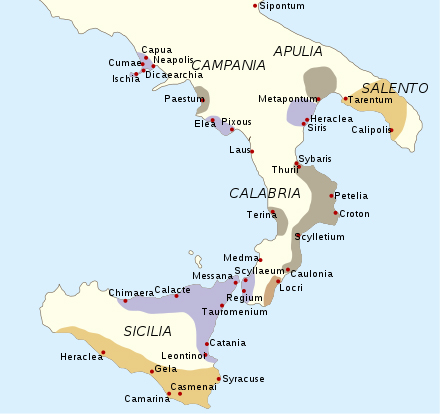
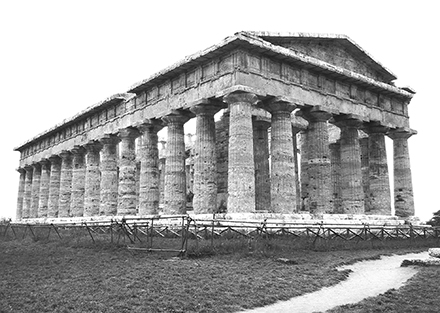
Much of the visual material that is used to support the book’s thesis is framed by the ‘concept’ of the villa, rather than its existence in reality. The Roman villa we are told has complex origins that have hardly been studied (p.136). However, despite this lack of research the origin of the villa that is emphasised throughout the book is that of the Hellenistic palatial villa owned by monarchs and potentates, which Romans came into direct contact with as a result of their expansionist policies. The fact that Neapolis and Pompeii existed in Magna Graecia, Southern Italy, and were therefore essentially part of Greece for over five hundred years prior to Roman expansionism is down played in favour of the ‘foreign’ and therefore more exotic ‘other’ (fig.1).The Greek temples at Paestum, situated a short distance south of Pompeii illustrates this point only too clearly (fig.2).
By citing an exotic source, villa ownership becomes synonymous with wealth, tranquillity, leisure and luxury and indeed these are the epithets that continuously crop up throughout the book, regardless of the type of villa being discussed. Despite their opulence, these exotic villas of desire seem to be eerily devoid of people. Not unlike the excavated houses and villas at Pompeii at the present time. We are never given a sense of the many slaves required to run them, or the inevitable hustle and bustle that would have accompanied their daily duties. Even Trimalchio’s villa, which is so often used to epitomise hedonistic lifestyles, had its moments when masquerade collapsed into farce and even violence.
Zanker’s Pompeian houses and villas are devoid of social interaction, other than that associated with conspicuous consumption. There tranquillity is never shattered by the sound of children or street noise drifting in through the main entrance, which was left open during the day, possibly as an act of piousness. On the contrary the author’s strategy is to create an impossibly perfect ‘other’, against which Pompeian middle-class ‘taste’ is measured. At the same time the perfect ‘other’ is sometimes invested with a conspicuous sense of risk that is designed to make it seem seductive. In order to do this he points to the existence of a society within a society.
1


1 Magna Graecia refers to Greek settlements in Southern Itlay from 800 BC
2 Greek Temples at Paestum, 50 miles south of Pompeii
 2
2
|