 1
1The ‘miniature villa’
In order to support the thesis that the middle-classes attempted to emulate the lifestyle of the super rich by remodelling their urban properties into ‘miniature’ versions of luxurious villas, our attention is drawn to a property that is described as a ‘miniature villa’. In describing as a "Walt Disney world" the author leaves the reader in no doubt that he regarded it as a tasteless attempt to cram various architectural elements associated with Hellenistic villa architecture into a single villa (p.156). His argument is conducted despite the fact that there is no general agreement that the urban villa style in Pompeii, or elsewhere in Italy, directly evolved from Hellenistic sources. Nevertheless, the evolution of one into the other is portrayed as a process that inevitably resulted in debased imitative forms, which the author links to class divisions.
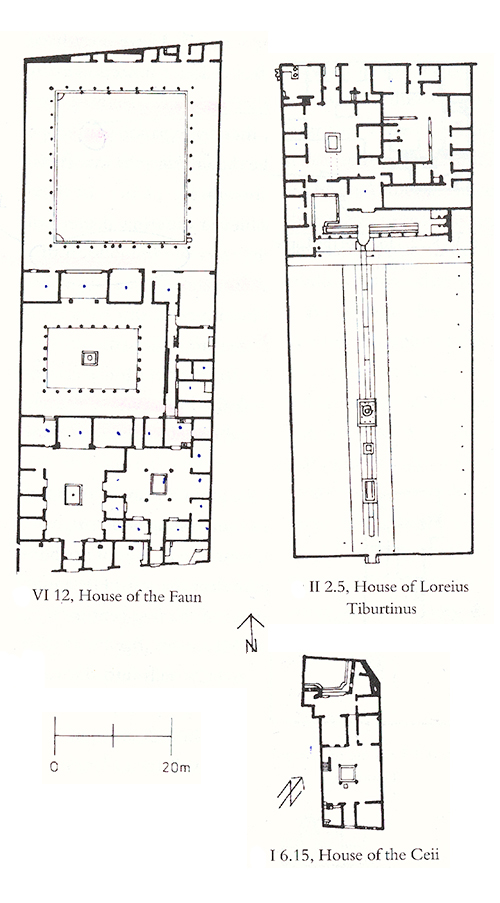
The so called ‘miniature villa’, which the text never links to a particular owner (except in diagram captions), is thought to have belonged to Octavius Quartio (also referred to as the House of Loreius Tiburtinus). No other sources refer to this property, located on the Via dell’ Abbondanza, as a “miniature” villa. On pages145-156, we are told that it represents a relatively poor mans attempt to imitate the luxurious villas of the very wealthy. Once again, the ‘real thing’ is never made visible to allow direct comparisons to be made. On the other hand we are constantly reminded that Hellenistic potentates owned them (p.145). On pages 194 and 195 we are shown plans of Pompeian houses all drawn to scale and amongst them is the plan of L. Tiburtinus (Reg II Insula 2.5), the so-called ‘miniature villa’. Adjacent to it is the ground plan of the House of the Faun (Reg VI, Insula 12), which is almost identical in size to that of the "miniature villa". Both occupy an entire insula. Numerous writers have noted that the House of the Faun was as large as some Hellenistic palaces. This publication makes the same point when it informs the reader that the enormous scale of the House of the Faun can only be compared with palaces found at Cyrenaica and Pella (p.35).
This presents a problem because the two plots are virtually equal in proportion and yet one is being described as palace-like and the other as a "miniature villa". Admittedly, by the time you have excluded the gardens and peristyle gardens from both plots the house of the Faun is larger, but not substantially, especially if we compare both with a more standard sized house, such as the House of the Ceii (fig. 1). On an approximate calculation the Ceii would fit into both the others more than seven times. The point that is being made here is that the House of Loreius Tiburtinus has been singled out by Zanker as a typical example of a house that is a tasteless caricature of a villa, largely due to a lack of space. However, as we have just seen, it occupied one of the largest plots of land in Pompeii. Therefore, the epithet that Zanker substitutes for the house’s more usual name seems somewhat misplaced.
Would-be villas such the House of Loreius Tiburtinus may have been "miniature" in comparison with royal villas on country estates, but by urban standards the so-called ‘miniature villa’ was very large. In which case why not simply refer to it as an urban dwelling with villa features? However, to do so would have undermined the social premise that underpins the book’s thesis, which requires an unattainable model. Thus the theme of ‘inferior’ miniaturisation is essential because it creates a separation that can then be used to denote a social difference between the ‘imitation’ and the ‘original’.
1


1 House of the Faun; House of Loreius Tiburtinus (Octavius Quartio); House of the Ceii
|