 1>
1>Palatial villa or safe anchorage
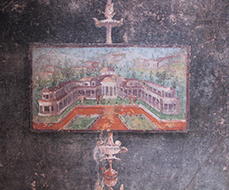
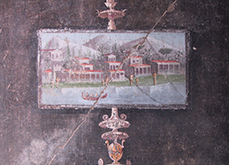
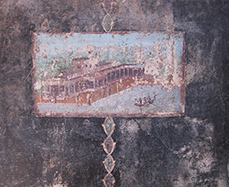
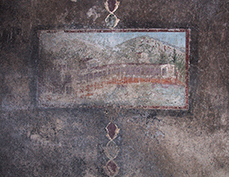
The underlying thesis in Pompeii: Public and Private Life is predicated on interpreting the material evidence, which is mainly visual imagery in the form of architecture and wall-paintings and the captions for the illustrations are invariably phrased in such a way as to persuade the reader to interpret them in a manner that supports the thesis. Not unusual in itself, except that in many cases neither the illustration or the accompanying caption is referred to or expanded upon in the main text. This is exemplified by Plate 16 in the case study (fig.2). It illustrates one of four vignettes in the tablinum of the House of M. Lucretius Fronto (V 4. 11) (figs 1-4). All of which are located within two larger compositions situated on facing walls. The vignettes are supported by ornate candelabra-like stands. Although not referred to in the main text Plate 16 is used to substantiate a fundamental aspect of the book’s thesis. The caption encourages the reader to think of the house owner as someone motivated by purely hedonistic desires. It begins by describing the vignette as a “Fresco imitation of a panel painting….showing a seaside villa.” We are then informed, “Depictions of luxurious villas are ubiquitous in Pompeian houses as symbols of a moneyed and cultivated lifestyle. Constant allusion to the world of the very rich remained characteristic of domestic decoration in Pompeii throughout the imperial era.”
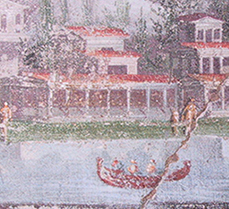
As discussed earlier, the word ‘imitation’ is used on several occasions to imply that imitation is synonymous with coveting. In this instance, the claim is that the wall-painting ‘imitated’ a painting previously produced on wooden panels. The implied inferiority is allied to it supposedly being a depiction of a ‘luxurious villa’, which is then used to evidence the thesis that the middle-class used the medium of paint to imitate the unattainable artefacts and possessions of the rich. But what is being imitated? If the original was a panel painting then we are offered no evidence of its previous existence and the entire composition could just as easily have been chosen from a ‘pattern book’ that enabled owners to select compositions. As to the claim that the purpose of the vignette was to depict ‘ luxurious villas’, that is pure supposition. The villa may not be the primary subject. Indeed J.J. Pollitt in his essay “Rome: The Republic and Early Empire”, page 285, (in The Oxford History of Classical Art, 1993) describes the vignettes as ‘harbour-scapes’. Perhaps the boat and the figures awaiting its arrival or departure is the subject, in which case the villa is simply a contextualising backdrop (fig. 5).
The author is so obsessed with seeing the villa in the vignette as a signifier of middle class aspiration that he fails to consider other key elements in the painting, such as the boat. The boat could well have a symbolic significance relating to safe arrival or auspicious departure, and the ambiguously sized figures on the bank could well represent either humans or in some cases statues of gods associated with the sea, such as Poseidon and Fortuna. Thus making the painting an idyllic version of the type of harbour scenes found on sepulchral monuments. The tomb of Naevoleia Tyche on the street of tombs located outside of Pompeii features just such an image (fig.6). Its location and the fact that the sails are being furled suggests safe arrival in an eschatological sense. This is a particularly poignant metaphor given Pompeii’s proximity to the sea. Cicero uses a similar metaphor when thinking about his own demise “The nearer I come to the hour of death, the more I feel like a man who has sighted land, and who knows he will soon enter harbour after his long voyage.” (Lyttleton 1984:49). A floor mosaic in the entrance to the Casa dell'Ancora evokes the same theme.



1 House of M Lucretius Fronto, tablinum, vignette, right wall left side.
2 House of M Lucretius Fronto, tablinum, vignette, right wall right side, this image corresponds to Plate 16 in Pompeii - Public and Private Life.
3 House of M Lucretius Fronto, tablinum, vignette, left wall left side, this is the only vignette not to depict a boat, however, the tholos or tempietta routunda (round temple) placed at the centre of the building suggests an auspicious theme associated with the departure and arrival of deities.
4 House of M Lucretius Fronto, tablinum, vignette, left wall right side.
5 Detail showing the boat in fig. 2 (above).
6
Tomb of Naevoleia Tyche, Pompeii, bas-relief depicting a boat furling its sails thus denoting arrival into harbour.
 6>
6>
|