 1
1The idea that art can operate on the level of metaphor and symbol, has no place in the author’s thesis, other than as an expression of personal gratification, literal readings take precedent throughout. On page 199 he makes the bold statement that virtually nothing in the décor of these late Pompeian houses related to their daily lives or their religious beliefs. Even the ever present lararium or household shrine is made to appear as if relegated to some insignificant corner of the house, thus making its presence an act of mere tokenism. This astonishing claim runs counter to all the literature relating to lararia and the daily rituals associated with them. On this theme see: Boyce 1937; Foss 1997; Froehlich 1991; Giacobello 2008; Orr 978; and the section on lararia in this publication.
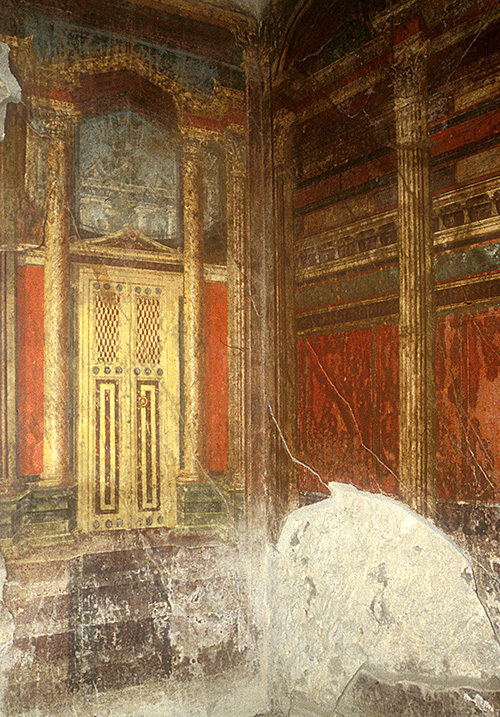
This lack of religious or symbolic readings attached to wall-paintings is also evidenced in another publication by the same author. On page 28 of The Power of Images in the Age of Augustus, Zanker argues that the ‘Architectural Style’, or Second Style of Roman wall-painting, was emblematic of the upper-class Roman’s ‘neurotic obsession’ with acquiring ‘fabulous splendour’. ‘Even’ in small bedrooms, we are pointedly told that ‘impressive architectural fantasies’ were used to quench the neurotic desire for ‘ultimate extravagance’, even though the ‘disconcerting optical effect’ of the architectural facades would not, in the authors view, have been conducive to sleeping (fig.1). The later comment reveals a superficial reading of the imagery that is being used to exemplify his argument. For him the painting in cubiculum 16 in the Villa of the Mysteries simply denotes excessively lavish palatial architecture absurdly placed in a small bedroom, whereas in reality the paintings place the sleeper in a liminal space surrounded by views into sanctuaries – a theme very conducive to peaceful repose. Elizabeth Bartman very astutely criticises Zanker for evaluating the paintings in Bedroom 16 using his own values, “ – a cubiculum at the Villa of the Mysteries in Pompeii, Zanker argues, is so extreme in its illusionism as to have a potentially disruptive effect on sleep. Here Zanker projects his own values rather than trying to discern the appeal that such a space might have had for its Roman occupant” (Bartman 1990: 276). The fact that bedrooms were found to contain some of the most sophisticated wall-paintings also runs counter to Zanker’s thesis. If hedonistic desire was at the core of Pompeian lifestyle, as he so often claims, why would they have lavished to so much money on rooms that very few were allowed to visit.
Using artefacts as evidence of human action may sound like the answer to a social historians dream, but it is also quite clearly an approach that is not without its problems, some of which have been highlighted in the above case study. As several French writers have pointed out, Barthes, Bourdieu, Foucault et al, determining an artefact’s semiological and semantic code is by no means a straightforward task. If one is going to use an artefact as a key to unlocking a social process, then it would seem sensible not to prejudge the nature of the artefact and Zanker, by designating artefacts such as wall-paintings as luxury items per se, is doing precisely that.
1


1 Villa of the Mysteries, Pompeii, cubiculum (bedroom) 16
|