 1
1Clearly this is not a courtyard to be entered except by those sanctioned to do so. However, Zanker ignores all of this in favour of an obscure reference to a ‘similar view’ located on a Nile palace ship owned by Ptolemy IV. (p.143). This link is somewhat bizarre to say the least and is clearly intended to support his view that the tholos in the painting is a ‘Hellenistic’ temple, whilst at the same time conflating it with royalty and royal palaces, albeit floating ones. Temples such as these were not specifically Hellenistic inventions, but date back to ancient Greek and even earlier near eastern sources. The tholos at Delphi being a notable example. They were also commonly used architectural forms in Roman Italy and its colonies, usually signifying a shrine, tomb or a temple.
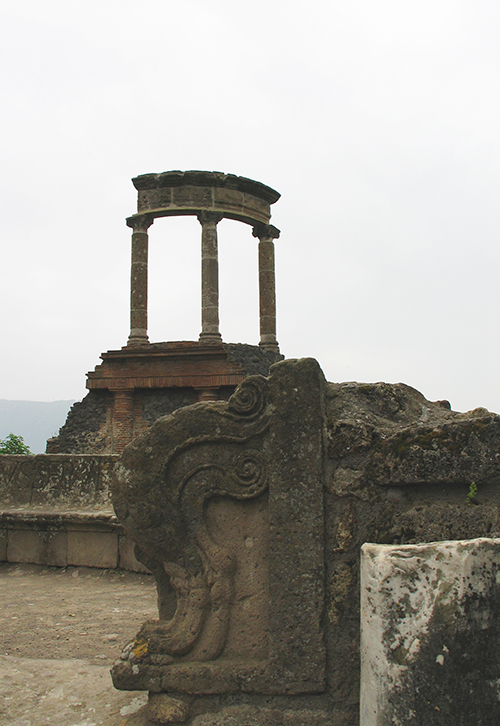
The full implications of this particular painting vis-à-vis it representing a sanctuary are examined in detail in my chapter Worshiping the House. Here it is only necessary to challenge Zanker’s attempt to conflate it with the desire to imitate luxurious villas by pointing out that the tholos had no exclusive relationship to villa or palace architecture. Nor did the owner of the House of the Labyrinth have to seek obscure associations with exotic Nilotic floating palaces. The ancient Greek part of Pompeii contained a tholos that was built several hundred years before the House of the Labyrinth. The roads leading into Pompeii also contained several examples of tholoi tombs (fig.1).
Throughout his book Zanker sights ‘domestic’ art as evidence of social aspiration without actually determining the aesthetic or semantic value placed upon it by those who lived amongst it. The palatial villa or royal palace that he uses to epitomise both social aspiration and hedonistic desire is entirely derived from literary sources, whilst its supposed imitation is achieved through art, and in particular the type of virtual illusion that wall-paintings are capable of creating. The literary construction is held up as pure, original and unattainable, whilst the visually tangible forms are demoted to the status of second-rate imitations. His approach echoes that of August Mau, who not only unashamedly applied his own aesthetic values to the study of Pompeian wall-painting, but also evaluated its quality by comparing it to nineteenth century easel paintings by artists such as Raphael Mengs. Clearly he didn’t agree with the proposition that the concept of ‘progress’ in art is an anathema that sets it apart from other forms of human endeavour.
In publications such Pompeii - Public and Private Life, art is used paradoxically as both the symptom of desire and its cure. But the art itself is never given a voice, other than that of the contemporary author. His thesis, and its denouement, requires him to single-mindedly locate ‘domestic art’ within a closed loop in which impossible desires are gratified by art, art is symptomatic of luxury, luxury is symptomatic of desire, impossible desires are gratified by art, art is …and so on. In this context the only value it possesses is that of evidence, which can be used to prove that the owner’s aesthetic judgement was driven by avarice. If the mere presence of art, regardless of any specific qualities that it may possess, is taken to be symptomatic of luxury and therefore hedonism, then one can have no argument with the book’s thesis. However, the ramifications of such a viewpoint would be enormously damning for the whole of the history of art and its ownership. 'Religious art' being a case in point. And yet there is an underlying assumption throughout that art, wealth and luxury are synonymous and that the ownership of art per se is indicative of the desire for social status.
1


1 Remains of a tholos tomb on the street of tombs leading to the Herculaneum gate, Pompeii
|