 1>
1>Temples in entrances
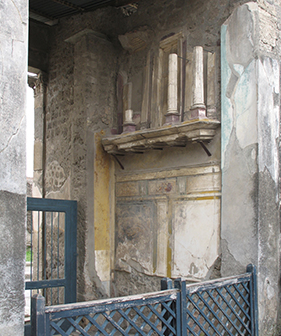
The author unwittingly draws our attention to apotropaic elements in the entrance to the House of the Faun when he highlights two temple-like structures on the upper sections of the walls, either side of the entrance. (fig.1). These are described as ill proportioned in relation to the scale of the entrance, with the result that their overly imposing scale was more likely to have had a ‘menacing’ effect, rather than the desired one which was to impress those entering (p.38). His use of the word ‘menacing’ to denote the owner’s failure to impress is more than a little ironic in this particular context. Much of the imagery associated with Pompeian entrances, which are generally referred to as the fauces, meaning throat to the body of the dwelling, was intended to either ward of evil spirits or alternatively to encourage prosperity to enter the house. What better way of warding evil, or ‘menacing’ those with evil intent, then having the home of the gods flank the entrance to your house.
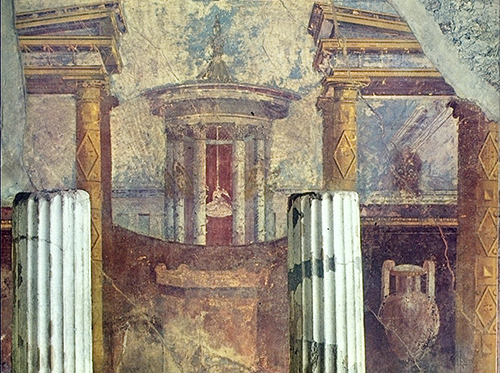
On page 143 we are told that other Pompeian houses of the same period as the House of the Faun (c.100 BC) contained even ‘richer’ copies of Hellenistic décor. This is illustrated by referring the reader to the Corinthian oecus in the House of the Labyrinth (fig.2). The author informs us that this large colonnaded room was ‘inspired’ by the villa style, but that its wall-paintings were designed to denote palatial Hellenism. The proof is provided by describing (fig.2) as a ‘palace courtyard’ with a circular ‘Hellenistic temple’ at its centre. No illustration accompanies the description, although a footnote refers the reader to an illustration in another book. (Schefold 1962: 36-37, 41ff., plates 3.2 and 20) His description is made to sound factual, whilst at the same time conveniently omitting several important iconic elements that would have undermined his thesis; neither are we given any hint of it being a highly controversial painting, other than a footnote that refers the reader to a dispute over its date. In actual fact, it is probably one of the Pompeian wall-paintings that is most argued over and has been used to support various theories, the most notable being H. G. Beyen's attempts to link it to ancient theatre scenery.
If we compare Zanker’s description of the painting on page 143 with the painting itself interesting anomalies begin to emerge. Firstly he informs the reader that it depicts a courtyard belonging to a palace and indeed the architectural elements are impressive. Setting aside the obvious inconsistency of using a pictorial representation of a supposed palace to prove a link with villa architecture, the next thing we are told is that in the middle of the courtyard is a ‘small’ circular temple. In a factual sense the temple, normally called a tholos, is small in relation to the virtual space it inhabits. However, in terms of psychological scale, its central position plus the fact that all the other elements of the composition appear to point to it, indicates that it is in actuality the subject of the painting. As such, this counters the authors observation that we are looking into a palace courtyard and instead implies that we are looking into a sanctuary. In which case this is not a palace courtyard, but a temenos, a sacred space defined by walls or colonnades. Several other motifs in the painting support this reading. These are: apotropaic masks (either side of the entrance), ex-voto food images (fowl and wine jar) and the walled up entrance with a depiction of an altar upon it, indicating a sacred space - a temenos.
1>


1 Entrance to the House of the Faun, Pompeii, flanked by temple imagery
2 Corinthian oecus, House of the Labyrinth, Pompeii, wall-painting depicting the entrance to a temenos sanctuary containing a tholos.
|