 1>
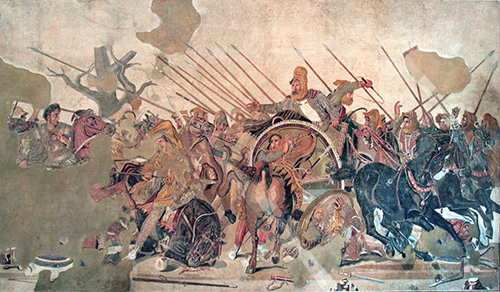
1>Historically speaking the Alexander mosaic discovered in the House of the Faun is probably one of the most important yet discovered, but despite this its sophisticated qualities relating to compositional complexity and use of perspective are never discussed (fig.1). Instead, it is only referred to as a copy of a lost Greek painting and as evidence of the owner’s desire to identify himself with Hellenistic culture. The mosaic’s Greek theme is interpreted as a ‘blatant’ attempt to display the fact that the owner was an educated man. However, we are not allowed to assume from this or from the fact that he possessed a valuable art collection, that he was a connoisseur.
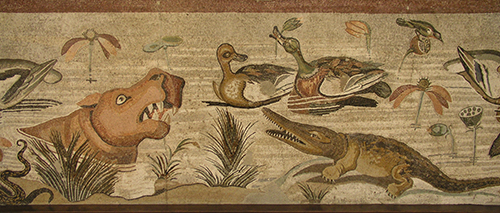
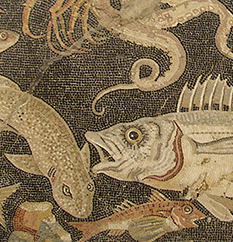
This damming conclusion is entirely based upon another mosaic situated near by, which he does not illustrate, but his reference to a crocodile and a hippopotamus suggest that it is the one illustrated in (fig.2). The mosaic itself is somewhat misleadingly described as having a ‘primitive style’, and presumably we are supposed to infer from this that the owners aesthetic judgement was also ‘primitive’, thus preventing him from being a true connoisseur (owners of Douanier Henri Rousseau paintings please take note). Zanker’s intention is to cast doubt on the owner’s aesthetic judgement in order to prove that his adoption of Hellenistic art was merely a superficial veneer. However, by using the word ‘primitive’ to critique this particular mosaic he inadvertently touches upon a range of aesthetic possibilities that actually undermine his argument. In comparison with the spatial sophistication of the Alexander mosaics the Nilotic landscape may well appear ‘primitive’, but only in the sense of having a child-like naïve innocence similar to that found in other mosaics of the period. It is even conceivable that this particular mosaic may have been commissioned by the owner in order to amuse children and adults alike. We should not therefore confuse its supposed naïvety or “primitiveness” with a lack of sophistication, quite the opposite. Clearly Zanker wished to conflate naïvety with a lack of connoisseurship on the part of the owner. However, he does not do the opposite when considering the exceptionally high level of verisimilitude, bordering on scientific observation, in the mosaic depicted in his Plate 2 (fig.3). Indeed, the degree of verisimilitude is so exceptional that it enabled marine scientists to identify the fossil remains of a fish that was thought to be extinct, but later found surviving in the deep ocean. The fact that the owner possessed and displayed ‘refined’ and ‘primitive’ mosaics could well be taken as a sign of cultural sophistication. Some of the most visually stunning mosaics from Pompeii, now housed in the Archaeological Museum in Naples, come from the House of the Faun.
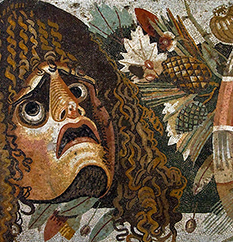
A mosaic located in the entrance to the House of the Faun (fig.4) is cited as yet further evidence of the owner’s vain attempt to ‘appear’ both educated and culturally sophisticated. No illustration is forthcoming, but the author selects from the mosaic’s rich mixture of images, Dionysian drums and tragedian masks as indicators of classical learning, which we are then informed were signifiers of a ‘hedonistic lifestyle’ (p.39). The symbolic references depicted in the mosaic were common currency throughout Pompeii and the Mediterranean world and, therefore, it would seem unlikely that the owner would have commissioned them in order to demonstrate his superior learning. As to them being signifiers of his hedonistic life-style, it is more likely that the simultaneous references to abundance, tragedy and rebirth contained in the mosaic were placed in the entrance of the house for auspicious, if not apotropaic reasons. Impressing visitors by displaying affinities with Greek culture may have been a marginal element, but a more typical objective associated with entrance décor was protection denoted by apotropaic imagery. Other elements in the entrance area support this view.
1>


 3>
3>1 Alexander and Darius mosaic - House of the Faun, Pompeii, now in the National Archaeological Museum, Naples
2 Nilotic mosaic - House of the Faun, Pompeii, now in the National Archaeological Museum, Naples
3 Fish mosaic - House of the Faun, Pompeii, now in the National Archaeological Museum, Naples
4
Abundance and tragedy, threshold mosaic - House of the Faun, Pompeii, now in the National Archaeological Museum, Naples
|