 1
1We are instead constantly reminded that the object of Pompeian hedonistic desire that caused them to produce the décor that they did, lay elsewhere in a foreign world – a royal Hellenistic world. However, much earlier in the book on page 32 we are told that Pompeii was already a Hellenistic city by around 150 BC, with town houses that rivalled the palaces of Hellenistic royalty. Nor does the author refer to the fact that from the 2nd century B.C. the agrarian economy in the surrounding countryside had been gradually reshaping itself into what Maurizio Gualtieri refers to as the ‘villa-system’, as opposed to numerous small peasant farms. (Maurizio Gualtieri, 1999, ‘The Western Greeks and Rome in Southern Italy’, JRA, V.12, pp.507-511.). Collectively, this more than implies that models for a villa lifestyle lay much closer at hand than Zanker would have us believe. However villa farms sound less exotic than Royal Palaces and charges of hedonistic desire would be far less meaningful if associated with the former, or even with the opulent villa style dwellings of ones rich neighbours.
It is also worth noting that when he discusses the earlier villa-style palatial house and their adoption of Hellenistic culture he does not initially do so in pejorative terms. Instead we are told that the ‘upper-class’ inhabitants ‘acquired’ Hellenistic culture, because it enabled them to ‘link’ to broader Mediterranean trends (p.32). The implication being that geographically and socially they were a part of this broader culture anyway. No such geo-social privileges are extended to the later ‘middle-class’ inhabitants of Pompeii. Their attempt to associate with the broader Mediterranean world is interpreted as avaristic ‘imitation’, rather than an act of acquiring motivated by cultural empathy. However, even ‘upper-class’ empathy soon turns to covetous desire as Zanker begins to discuss the contents of the houses owned by the ‘old’ families.
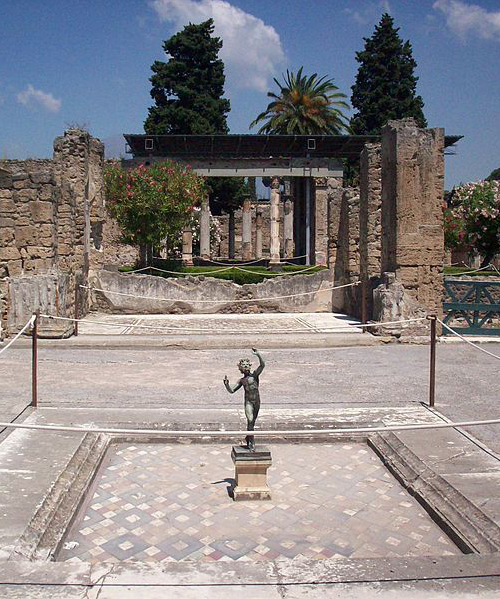
In a subsection titled The Old Families and Their “Palaces’’ (pp. 33-43) the House of the Faun is used as a flagship example of the type of domestic opulence that the very rich indulged in (p.35). Because of its scale, this particular house is not likened to royal villas but to a palace belonging to a foreign monarch or potentate (fig.1). This point is reiterated later in the chapter on ‘domestic art’ (p.142). Here the reader is reminded that the House of the Faun was not ‘derived’ from the villa style, despite the fact that it had all the architectural features normally associated with villa architecture, such as peristyle gardens, fountains, mosaics, paintings and numerous rooms with views on to gardens. Distancing such buildings and their luxurious contents from the image of the villa is necessary because their presence in Pompeii at this early date challenges Zanker’s thesis that some one hundred and sixty years later the ‘middle-class’ tried to imitate the villa life-style of ‘foreign’ royalty. And yet, if we compare these later buildings with the House of the Faun we find all the same elements being used, the only difference being scale. With regard to quality, even the owner of this particularly palatial house is not beyond reproach for displaying a lack of connoisseurship.
His house is initially portrayed as the epitome of the ‘Greek cult of luxury’ and artworks such as the Alexander mosaic are called upon to exemplify this. At the same time we are told that we should not conclude from the presence of such works that the owner was a connoisseur (pp.40&41).
1


1 House of the Faun, Pompeii - viewed from what was the atrium, leading to the tablinum (where the Alexander mosaic was located) and then to the double peristyle garden
|