 1>
1>The presence of paradeisoi (idealised nature) and fountains (water motifs), both common features associated with a nymphaeum, are reinterpreted as features imitative of opulent villas and their gardens. Alternative readings are countered by pointing out, in the caption to his fig.109 (my fig.1 on the previous page), that the various components lack any ‘realistic’ interconnectedness, as illustrated by the fact that images of fish appear above images of vegetation. Why logical arrangements and ‘realism’ should be a determining factor in a stylised ‘grotto’ normally associated with nymphs and water spirits is never explained. However, they become the criteria by which the room is eventually described as a ‘grotesque potpourri’.
Apart from the irony of using the word grotesque in this context, Zanker’s observations are largely based upon material evidence that is in a very dilapidated condition. This alone would suggest approaching the material with extreme caution, let alone applying modern criteria to its evaluation. However, despite this he attempts to conjure up the picture of an uncouth owner only concerned with pursuing desires above his status. He also patronises the inhabitants of the house by implying that they must have had extraordinary imaginative skills that allowed them to ‘overlook’ the obvious formal inconsistencies that he has alerted us to.
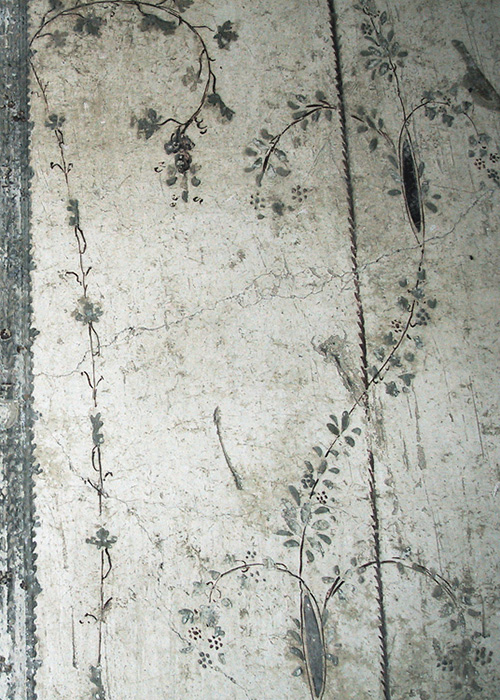
In addition to the obvious problems concerned with his critical methods, there is another fundamental reason why his attack upon the owner's sensibilities is erroneous. If we enter other rooms in the same house we find wall-paintings that are anything but uncouth. One painting in particular is often singled out as an exceptional example of Fourth Style vegetal motifs (fig.1). Roger Ling in his book on Roman painting refers to it as comparable in quality to the delicacy of vegetal-motifs found in the oecus of the House of the Vetti (Ling 1991: 82). Several figurative works from this house were singled out for their quality and sensitivity to the medium of paint in Paintings from Pompeii – Evidence of Roman art buried by Vesuvius in AD 79, Éditions Hazan, 1999, pls. 93-96: illust., 97&98. All of which highlights the problems that arises when you try to establish not only someone’s character but also their ‘tastes’ by focusing upon a very limited amount of visual evidence. A case in point is the previously discussed image of Priapus located in the entrance to the House of the Vetti. The reading of this image in terms of is raison d’être is crucial because read one way it might signify the hedonistic pursuit of monetary wealth and read a different way it could well signify the opposite in terms of valuing nature above wealth.
Domestic Arts or Art in a Domestic Context?
“The Domestic Arts in Pompeii” constitutes just over one third of the entire book. However, the period of ‘domestic art’ that it comments on turns out to be no more than the last seventeen years of the cities existence. A period defined by the AD62 earthquake and the final devastating eruption in AD79. Since the author does not specify or acknowledge this time frame in relation to the chapter’s focus, it inadvertently becomes representative of Pompeian ‘domestic art’ in general. A position that is re-enforced by the very few references that are made to the art that immediately proceeds this period, or for that matter to the previous 700 or so years of the cities existence.
1>


1 Wall-painting depicting delicate vegetal motifs, House of the Centenarian
|