 1
1Therefore Death itself is not the subject of the mosaic, but rather its capacity to reduce all human beings to the same level, thus perhaps reminding the observer that one should attempt to live ones life in an honest and fulfilling way regardless of one’s status, because in the end all are deduced to the same status. Once again not a message that a vainly ambitions hedonist would be comfortable with, let alone wish to dine upon.
Nymphaeum
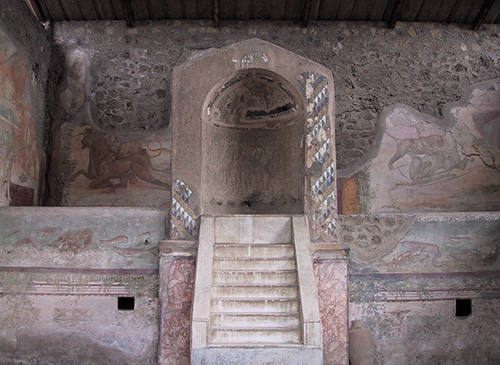
On several occasions, throughout Zanker's book, house décor and wall-painting in particular are evaluated according to the author's own aesthetic values. His description of the nymphaeum in the House of the Centenarian (IX 8.6) is a particularly clear example of this (fig.1). The décor is referred as a ‘grotesque potpourri’ (p.189) without any clarification as to how this damning judgement is arrived at, other than by applying the author's own contemporary sense of ‘organic harmony’ (p141). Unsubstantiated criticism such as this is fairly typical of the way in which the artefacts are debased via comparison with non-specified originals or the application of the author’s own aesthetic values. When he refers to the paintings in the nymphaeum in the House of the Centenarian as a ‘grotesque potpourri’ should we infer from this that it was also viewed as such in its own day and if so - by whom? The problems associated with applying contemporary values to ancient contexts are well understood and therefore requires no further comment, other than to say that we now live in a postmodern world which might lead us to interpret the nymphaeum not as a ‘grotesque potpourri’ but as a ‘knowingly ironic pluralistic composition’. All of which highlights the absurdity of using modern sensibilities to evaluate the taste of previous generations.
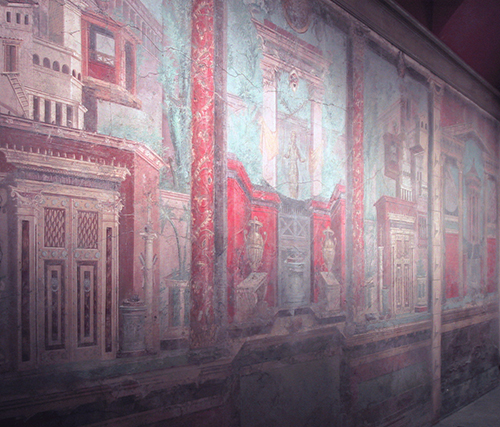
But what is it about this particular room that caused Zanker to criticise it using such provocative language? In the paragraph immediately prior to his comments on the nymphaeum, we are told that the owners of such rooms were only interested in having large-scale paintings that projected their hedonistic fantasies. A logically arranged ensemble of paintings set in spatially consistent locations was apparently of no concern to them, because conspicuous display was their only objective. The evidence that is put forward for these observations is an absence of framing devices around the paintings. He argues that this would have keyed the paintings into the architectural space in which they are located, thereby making for a more logical and coherent arrangement. This is a surprising criticism, because if the owners of these rooms wanted to turn them into conspicuously luxurious fantasy worlds, which the author continuously accuses them of, then surely removing the frames that anchored the paintings to the real world would have been a major part of the strategy. Large-scale trompe l’oeil paintings do just that, they create a seamless bridge between real and virtual realities thus luring the viewer into a world of their making (fig.2).
Having accused the post earthquake nouveau riche of blatant self-aggrandisement, the nymphaeum is then brought forward as a typical example of how they tried and failed to achieve this by means of pictorial fantasies.
1


1 Nymphaeum in House of the Centenarian, Pompeii
2
Villa P. Fannius Synistor, Boscoreale - bedroom M is a good example of trompe l'oeil creating a virtual world beyond the confines of the room, now in the Metropolitan Museum of Art, New York
|