 1>
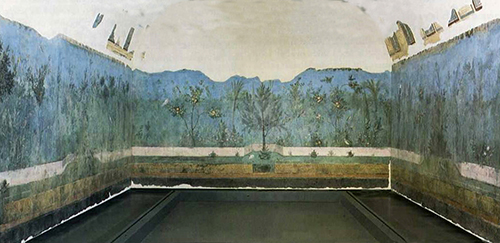
1>Does the presence of a paradeisos wall-painting in Livia's villa also indicate that she too was imitating Hellenistic palatial villas and the life-style that went with them, If so why? As the wife of Augustus, she above all woman in the late Republic was the mostly likely to be considered 'royal', and yet she too chose to have an exotic garden view painted in a grotto-like room in her villa? Her enchanted paradeisos contained fruit trees, exotic flowers and colourful birds (fig1). And, as the name implies, it projects a sense of Elysian tranquillity and primordial bliss. Even Livia, or perhaps especially Livia, was not beyond being exposed to the traumas of the real world, and paintings such as these may have provided a respite from the real world, albeit for an illusory moment. There is absolutely no reason why Pompeians would not have commissioned them for exactly the same cathartic reason. A jagged cave edge motif similar to that found in the Orpheus painting, is depicted along the top of the painting. The barrel vaulted ceiling above the painting reinforces the impression that one is situated in a cave from which one can see into paradise.
Death’s-Head mosaic
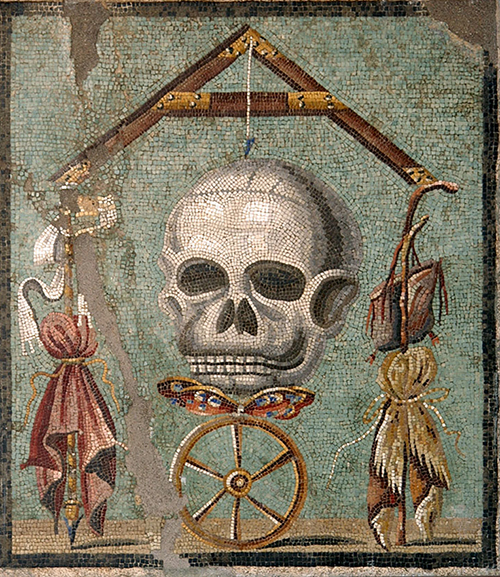
Another work of art that may represent a further glitch in Zanker’s thesis relating to paradeisoi gardens as a projection of ‘unbridled’ hedonism, is the Death’s-Head mosaic that formed the top of a garden table (fig.2). As Otto Brendel points out this mosaic represents a significant departure from the mytho-poetic personification of death found in Greek art, in which Thanatos (death) and Hypnos (sleep) form a symbiotic relationship. (Otto J. Brendel, ‘Observations on the Allegory of the Pompeian Death’s-Head Mosaic’, in The Visible Idea: Interpretations of Classical Art. 1980 pp.7-26.) The mosaic presents an emblematic, but nevertheless chilling, reminder that death is the inescapable event that reduces all mortals to the same status. Hardly an image that a hedonist would wish to be reminded of whilst enjoying a meal in his pretend ‘royal garden’. Brendel interpreted this mosaic as being almost scientific in its objectivity and for him that signified the pragmatic Italo-Roman attitude to death, which he contrasted with its deified form in Greek mythology.
Stripped of any idealising references the mosaic appears brutally direct in its use of visual signifiers, all of which would have been immediately apparent to the contemporary viewer, who would have deciphered more in it than simply a crude reference to death as symbolised by the skull. This mosaic is not an invitation to enjoy life’s pleasures while you can! To do so would mean ignoring the visual-narrative embedded in the composition. The transience of life is undoubtedly symbolised by the presence of the skull and the butterfly. The wheel, as an attribute of both Nemesis (equilibrium) and Tyche (fortune), would also have reminded the observer of their own personal impermanence in the larger order of things. The creator of this mosaic was not simply content with reminding the would-be hedonist of his eventual demise, because he went on to narrate a further pious message, which is indicated by the perfectly counterbalanced objects hanging from the builders levelling tool. The hanging assemblages stand in direct contrast to each other, one is composed of a shepherds crook, sack and ragged garments, whilst on the other side hangs a sceptre and purple robe, both images of Imperial power. The fact that the plumb line hangs vertically with its lead weight pointing at the skull indicates that both of the hanging elements have the same weight, thus pointing out that the rich, the powerful and the poor are all equal in death.
1>


1 Paradeisos in the villa of Livia Drusilla, Prima Porta, near Rome
2 Deaths head mosaic, National Archaeological Museum, Naples
|