 1
1Therefore, it would seem that the owner was also someone in search of philosophical understanding, as well as ‘luxury’. As a devotee of Epicurus and his followers he would have been exposed to the concept that self-restraint and denial, rather than unrestrained hedonism, was the solution to the fundamental problem concerning the achievement of ‘profound’ happiness. This begs the question: which collection is indicative of the owner’s lifestyle, the scrolls or the sculptures? Or, in the light of the scrolls and the very explicit philosophical position that they advocate, should we reassess the owner’s reasons for assembling the collection of sculptures.
Paradeisoi
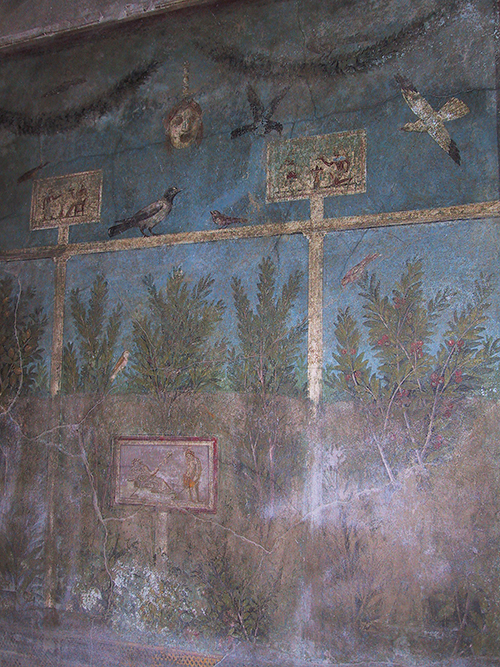
The owners of the wall-paintings, as discussed in Pompeii - Public and Private Life, are never credited with the type of ambiguous collecting patterns that we see in the Villa of the Papyri. For example paradeisoi (wall-paintings featuring enchanted gardens) are not allowed to be what their name implies, but are instead cited as yet another example of the Pompeian middle-classes trying to emulate the opulent life-style of Hellenistic rulers. The author selectively refers the reader to examples that he claims were produced after the AD62 earthquake. The dating is important because it allowed him to connect them to the men who supposedly profited from the earthquake. But like the majority of dates associated with Pompeian artefacts they are debatable (p.198). Their new found wealth, we are led to believe, enabled them to engage in a restoration programme designed to create, via imitative wall-paintings, the unattainable life-style associated with paradeisoi. Is it inconceivable that a society that has just survived a devastating earthquake, might wish to surround itself with cathartic images rather than ones motivated by avarice? Also, the origin and significance of paradeisos wall-paintings is by no means as clear-cut as this book would have us believe.
Ernesto de Carolis in his book on Gods and Heroes in Pompeii, whilst acknowledging Hellenistic influences also points to even more distant Persian origins. This makes sense given the fact that the word paradeisoi is of Persian origin, referring to a walled garden. He also makes it clear that this type of painting had a natural resonance with the Italo-Roman love of nature (Carolis 1999: 25). Desire and its fulfilment is invariably a complicated compromise. If the Pompeians had wanted to introduce nature into the domestic environment, in actuality and in stylised form, then it is likely that they would have commissioned the genre currently available to them (fig.1). If that genre in its turn was made up of distant Hellenistic and Persian influences, which they were not aware of, then it cannot be used to characterise them as covetous.
Villa of Livia Drusilla at Primaporta
The simplest and perhaps the most effect way of countering Zanker’s thesis concerning the use of garden wall-paintings to conjure up images of a life-style associated with royal villas, is to simply refer the reader to the paradeisos located in Livia’s villa at Primaporta.
1


1 Paradeisos wall-painting with Egyptian vignettes in the House of the Orchard, Pompeii
|