 1
1Elizabeth Bartman in her essay on ‘Sculptural Collecting and Display in the Private Realm’, tells us that Romans regarded eclecticism as a virtue and that collections of sculptures were highly prized precisely because they were made up of disparate periods, styles, themes and genealogies, all of which offered a conversational focus (Gazda 1991). And yet Zanker used this accepted approach to collecting as the very reason for criticising M. Lucretius’ taste in sculpture (p172).
A
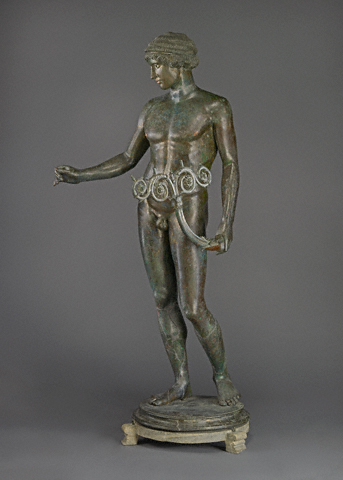
bronze statue of a ‘servant holding a candelabrum’ is one of the few pieces of sculpture that the author focuses upon in any detail (fig.1). Its caption describes it as valuable in monetary terms and therefore more likely to have been owned by a ‘wealthy’ villa owner, before becoming the property of its current owner who lived in a ‘modest’ house. No proof is given but the association that is made has the effect of reminding the reader of the low status of the current owner, since we are told that they could only acquire valuable things second hand. Its financial value is also reiterated in the main text, but this time as a way of associating the sculpture with dreams of luxurious villas (page 178). It is never referred to as an imitation, although quite clearly it is based upon Greek aesthetic principles. To have called it an imitation would have run counter to the notion of it being valuable and thus yet more evidence for the owner’s longing to join the ranks of the super rich. Instead it is described as recalling the type of sculpture found in ‘real’ i.e the villas of the wealthy.
It would seem that Zanker’s attempt to establish personal taste by means of sculptural collections is also fraught with methodological problems. Not least of which is the distinct possibility that the Pompeians were engaged in a pursuit that was by 62 A.D already subject to a set of Romanised conventions. Indeed Zanker in another article argues for this very point, when he says that Republican conventions regarding sculptural display continued to influence attitudes during the imperial period (Zur Funktion und Bedeutung griechischer Skulptur in der Romerzeit,’ in Le classicisme à Rome aux Ier siècles avant et après J.C. [Fondation Hardt, Entretiens sur l’antiquité classique 25, Geneva 1978] p.300). Therefore, scultural collections, such as the one owned by M. Lucretius, conformed to established Romanised patterns of collecting and were not necessarily produced by a desire to emulate distant Hellenistic patterns of collecting.
Villa of the Papyri
The Villa of the Papyri at Herculaneum contained an even larger collection of marble sculptures. Are we to infer from this that the owner was even guiltier of ostentatious display? Zanker would have us believe so when on page 141 he describes such collections as "haphazard", lacking in "organic harmony" and "excessive in their use of expensive materials (or imitation of them)". However, the owner also had another substantial collection that tells quite a different story. It was named the Villa of the Papyri because it contained one of the largest and most important collections of ancient scrolls ever found. What is even more perplexing and at the same time revealing from the point of view of this particular discussion on art as a manifestation of luxury, is that practically all of the scrolls so far analysed are philosophical texts, particularly Epicurean.
1


1 The above is reproduced in Pompeii - Public and Private Life, as fig.102 and described as a 'servant' holding a candelabrum, House of the Ephebe (now in the National Archaeological Museum, Naples).
|