6

5
1. Pablo Picasso Picador 1889
2. Pablo Picasso Waiting — or Margot 1901
3. Pablo Picasso Family of Saltimbanques 1905
4. Pablo Picasso Head 1907
5. Pablo Picasso Mother and Child 1921
Pablo Picasso Matriarchal - Machismo
Picasso’s artistic output is legendary and, like de Chirico, he explored numerous recurring themes throughout his lifetime. Generally speaking, the themes were visualised via an intense mixture of formal innovation and emotional depth and the terms commonly used to describe his work, such as Cubism, Blue Period, Rose Period and African period etc., do not do justice to both the imaginative and emotional depth that underpins his oeuvre. In contrast to the intellectual metaphysics that underpins de Chirico’s paintings, Picasso’s work is essentially physical and therefore visceral — human suffering, grief, loneliness, social anxiety, death and the curse and pleasure that attends sexuality are some of the pervading anxieties that recur throughout his life’s work (Figs.1-9).
His paintings, sculptures, prints and ceramics filled studio after studio, château after château and even a few castles. In Life with Picasso Françoise Gilot described her first visit to his studio on the Rue La Boétie, as still being full of his art and his possessions despite the fact that it had been unused for five years. Her vivid description echoes Howard Carter’s words on seeing Tutankhamen’s burial chamber packed with treasures in preparation for the boy Pharaoh’s after-life — "I see wonderful things." When she later went to his much larger country property at Boisgeloup she also experienced similar feelings caused by the sight of "wonderful" objects appearing to be in a state of limbo. Picasso’s will to possess and at the same time assuage loss seems to have existed in equal measure. This is exemplified by his prolific creativity combined with his legendary incapacity to throw away even the humblest of objects such as fingernail cuttings, old cloths and even cigarette ends. Had he not had the wealth to accommodate his pathological urge to create, possess and hoard, he may well have been clinically diagnosed as having Diogenes syndrome.
Picasso, unlike De Chirico, did not suffer actual parental bereavement at a young age. His transition to matriarchal dominance was a trajectory informed by patriarchal rejection. Initially, it took the form of a self-proclaimed rejection of the stultifying weight of bourgeois traditions in late nineteenth-century art, examples of which were very much in evidence in his local Art Museum in Malaga, which according to Kahnweiler, Picasso’s dealer, “…contained all sorts of hackneyed paintings by Malaga artists, friends of Don Ruiz, Picasso's father”. (Brassaï: 355) Hence, the tradition Picasso sought to reject was epitomised by his father’s Oedipal shadow as John Richardson astutely put it, and its unconditional acceptance of contemporary bourgeois values. (Richardson, Vol 1: 49) His father was a painter, art teacher and picture restorer, who practiced within the traditionally accepted norms of late nineteenth-century art and produced rather bland still-life and landscape paintings. Whilst still a very young child his father encouraged or “pushed” him to draw like an academician, which was something that Picasso came to regret, as he later pointed out to George Brassaï. “My very first drawings could never have appeared in an exhibition of children's drawings. The child's awkwardness and naiveté were almost completely absent from them. I very quickly moved beyond the stage of that marvellous vision. When I was that kid's age, I was doing academic drawings. The attention to detail, the precision in them frightened me. My father was a drawing teacher, and it was probably he who pushed me prematurely in that direction.” (Brassaï, G 1999: 115)
Picasso committed the ultimate patricidal act, not by cutting of the claws of his father’s pigeon, his father did that for him so that he could study them better, but by painting them so well that his father handed his brushes over to his young son never to paint again. This no doubt apocryphal story illustrates Picasso’s problematical relationship with bourgeois art history and his father’s emblematic relationship to it. The pigeon claws reappeared years later in his cubist paintings, along with cryptic references to his father. Having metaphorically castrated his own patriarchal lineage, the young Picasso then transferred his libidinal exigencies to the female line and not just in name only.

7
 1
1 8
8 4
4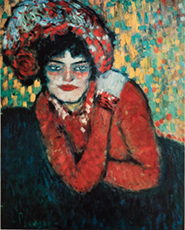 2
2 3
3
On the few occasions when his father reappeared in his art it was invariably in the guise of a bearded old man. Later in life, Picasso revealed to the photographer George Brassaï the thought that overwhelmed him when he painted bearded men: “……I accidentally think of my father. For me, man is Don José and that will be true all my life. He wore a beard. All the men I draw have more or less his features". (Brassaï, G. 1999: 66) What is perhaps even more telling in terms of following the matriarchal line is that paintings and drawings of his mother and women vastly outnumber those of his father and men.
 6
6 9
96. Pablo PicassoWoman and Beachhut 1928
7. Pablo Picasso Crucifixion 1930
8. Pablo Picasso Head of a Woman 1939
9. Pablo Picasso The Kiss 1969
6

